
THE LAST BUILDING STANDINGALSO BY COACH CRAIG BALL
A Place Where Leaders Are Built
What Small-Town Football Still Gets Right
- 2 -
Schools Won’t Disappear. They’ll Just Stop Working.A Framework for Saving What Happens Inside.A Working Framework byCoach Craig BallBlack Hawk, Colorado2026
- 3 -
THE LAST BUILDING STANDINGSchools Won’t Disappear. They’ll Just Stop Working.A Framework for Saving What Happens Inside.Copyright © 2026 by Coach Craig BallAll rights reserved.Published by Coach Craig BallBlack Hawk, ColoradoFirst Edition: March 2026 - Pre-Edited Edition - Dyslexic First Draft VersionNo part of this publication may be reproduced, distributed, or transmitted in any form or by any means, including photocopying, recording, or other electronic or mechanical methods, without the prior written permission of the author, except in the case of brief quotations embodied in critical reviews and certain other noncommercial uses permitted by copyright law.For permissions or inquiries
Coach Craig Ball
720.751.8771 Call or Text
[email protected]ISBN: [Pending]Cover design by: Coach Craig BallInterior layout by: Coach Craig BallPrinted in the United States of America
- 4 -
A FORMAL REQUEST
FROM A TEACHERThis book is a formal request from a classroom teacher to the administrators, school board members, parents, and communities who shape the conditions under which students learn and teachers work.It is a request for structural change in three areas that determine whether a school functions as a place of real learning or becomes another simulation in a world already full of them.Attention.
A school-wide phone ban during school hours, so that students are present in mind as well as body.A smartphone is not a distraction in the way a passed note was a distraction. It is a portal to every relationship, every conflict, every algorithmically optimized feed engineered to capture human attention. When a student has a phone in their pocket, they are not fully in the classroom. They cannot be. The phone represents an entire competing world, and that world is engineered to win.Phones also create a safety and supervision concern that schools have not yet fully reckoned with. Teachers cannot monitor hallways, bathrooms, and common areas while simultaneously managing a device that allows students to coordinate, record, and broadcast without adult awareness. Removing phones is not only an academic decision. It is a building safety decision.Thinking.
Clear, enforceable AI governance, so that students do the cognitive work their education requires.AI that supports effort is a tool. AI that replaces effort robs the student of the one thing the assignment was designed to build: their own capacity. The teacher still gets paid. The school still operates. The student is the one who lost something, and in most cases they do not even realize it yet.Without a clear, district-level AI policy, teachers are left to enforce a line the institution has not drawn. That is not a workable professional environment. Teachers need institutional ground to stand on, not silence from above and pressure from every direction.Presence.
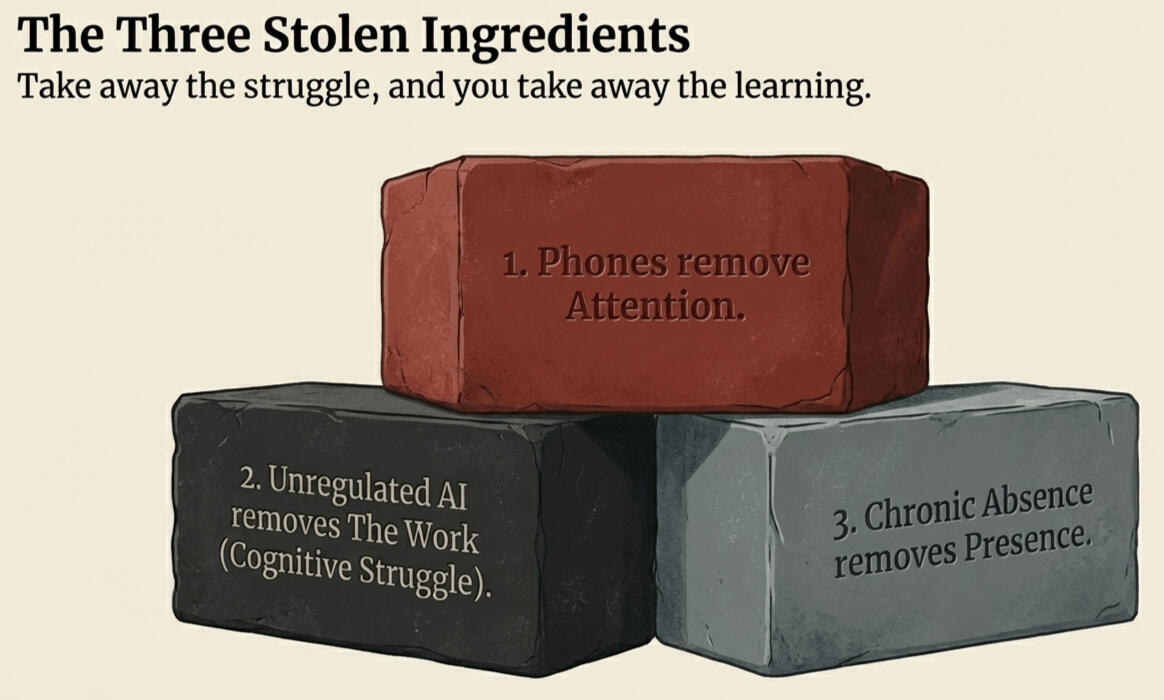
Structural attendance requirements, so that showing up is treated as the foundation it has always been.When attendance becomes optional, when a student can earn credit without being physically present, when online recovery replaces seat time, the institution loses its organizing principle. The teacher’s authority erodes. The classroom culture fractures. The diploma loses meaning, because it certifies completion without verifying investment.Attendance is also a safety issue. A school that does not know where its students are, that allows chronic absence without structural consequence, that graduates students it rarely saw, has created a liability it cannot explain if something goes wrong.These three problems are not three separate issues. They are one structural failure with three symptoms. Phones steal attention. AI misuse steals thinking. Attendance failures steal presence. All three trace back to institutions unwilling to make the decisions that would fix them.These changes are not requests for personal convenience. They are the structural conditions required for student learning, and for a safe, functional working environment for every teacher and staff member in the building.IMPLEMENTATION GOAL
August 2026After notice, inaction is a choice.This is not a complaint. It is a framework. The evidence is in these pages. The ask is clear. And the standard starts with us.
- 5 -
For the kid sitting in the third row
who does not yet know what they are capable of, because no one has required enough of them to find out.
...And for every teacher still holding the line.
..."These are charmed years when a student can become anything he wishes and when he has the opportunity to survey his alternatives, not merely those current in his time or provided by careers, but those available to him as a human being."
Allan Bloom, The Closing of the American Mind
..."The price of building something real has always been high. That has never been a reason not to build it."
The Last Building Standing
- 6 -
Table of Contents
Introduction Schools are The Last Building Standing: This introduction lays out the full case: phones are destroying attention, AI is replacing thinking, attendance is losing its meaning, and the simulation economy is making all of it worse. Everything the book argues starts here.
Coach's Note: "The Business of Behavior: Before We Hire Another Consultant" Schools keep hiring consultants to help teachers manage chaos that leadership created and refuses to fix. This note names the pattern, identifies who benefits from it, and explains why this book exists.
Chapter 1: "You Can't Handle the Truth" The Cake Needed Eggs The hidden problem revealed. When cake mix only required water, nobody valued it. When the company added eggs and butter back in, sales took off. This chapter explains why effort is the mechanism that creates value in education, and what happens when we remove it.
Chapter 2: "I See Dead People" The Phone in the Room Students cannot self-carry phones, and it is time to stop pretending they can. This chapter makes the case for removing phones during school hours and examines what schools on the other side of that decision are seeing.
Chapter 3: "Do You Want to Play a Game?" The AI Question AI is not going away. The question is whether schools integrate it without surrendering the struggle that makes learning real. This chapter draws one clear line: Did the student do the thinking?
Chapter 4: "If You Build It, They Will Come" Attendance Is Structural In athletics, nobody debates whether showing up matters. This chapter argues the classroom deserves the same structural logic and names the two cultures forming inside schools that can no longer coexist under the same roof.
Chapter 5: "What We've Got Here Is a Failure to Communicate" After Notice, Inaction Is a Choice The first four chapters named the problems. This chapter names the path forward. It restates the three structural asks, gives any teacher in any district a framework for pushing for change through proper channels, and applies the three pillars of leadership to the people responsible for the conditions inside our schools. The problems are fixable. The asks are reasonable. What happens next depends on whether leadership acts.
- 7 -
THE LAST BUILDING STANDINGSchools Won’t Disappear. They’ll Just Stop Working.A Framework for Saving What Happens Inside.This Book is for teachers, parents, administrators and school boards ready to frame the problem, start the conversation, and push for real change in schools across America.A Working Framework by Coach Craig Ball
THE LAST BUILDING STANDINGThe Book's Whiteboard Video
6 Minute Summary of the Book
INTRODUCTION
Everything You Need to Know
Something has shifted in American schools, and most of the people inside them can feel it even if they cannot name it. Attendance is declining. Attention is fracturing. Students complete assignments without understanding them. Diplomas are awarded to young people who were rarely in the building. Teachers are exhausted, not from the work itself but from the growing sense that the work no longer holds together the way it once did.This book argues that the shift is not mysterious. It is structural. And it can be named.We are living through a period in which the fundamental relationship between students and school is being redefined. Not by any single policy decision or technological breakthrough, but by the accumulated weight of a thousand systems optimized for the same thing: making life frictionless. Online credit recovery allows students to earn diplomas without physical investment. Artificial intelligence produces polished output without struggle. Smartphones collapse every boundary between the classroom and the infinite digital world outside it. Each of these forces, taken alone, looks like progress.
- 8 -
Taken together, they are dissolving the structural foundation that makes in-person schooling meaningful.This is not a technology problem. It is not a discipline problem. It is not a generational problem. It is a design problem. Schools were built on the assumption that students would be physically present, mentally engaged, and operating within shared constraints. That assumption is no longer guaranteed. And when the assumption breaks, everything built on top of it begins to erode. Classroom culture. Academic standards. The diploma itself.The Simulation EconomyThe forces pressing against schools did not arrive with a single announcement. They accumulated. They optimized. They made everything easier, faster, and more convenient. And in doing so, they made the hard, slow, inconvenient work of real learning look increasingly unnecessary.Consider what a student now has access to during a typical school day. A smartphone that connects them to every person they know, every piece of entertainment ever created, every social platform engineered to capture and hold their attention. An AI assistant that can write their essay, solve their math problem, summarize their reading, and generate a presentation, all in seconds, all without the student engaging in the cognitive work the assignment was designed to produce. An online credit recovery system that allows them to click through modules and receive credit for courses they never attended.None of these systems were designed to undermine education. Each was designed to solve a real problem: connecting people, extending capability, recovering lost credit, expanding access. But the cumulative effect is an environment in which the simulation of learning, the appearance of completion without the substance of effort, has become easier than actual learning. And when the simulation becomes easier than the real thing, the real thing loses.
- 9 -
This is what I mean by the simulation economy. Not a conspiracy. Not a villain. A thousand rational optimizations that, taken together, have created a world in which showing up, struggling, failing, and trying again, the basic architecture of learning, can be bypassed entirely. And behind each of those optimizations is a system that profits from the bypass. Technology companies profit from captured attention. Credit recovery vendors profit from lowered standards. Consulting firms profit from the dysfunction those decisions create. The incentive structure does not reward fixing the problem. It rewards managing it forever.What School Is ForIf school were only about content delivery, the simulation economy would have already won. Content is everywhere. Lectures are on YouTube. Textbooks are online. AI can explain almost any concept in almost any way to almost any learner at almost any level. If the only purpose of school were to transfer information from one place to another, we would not need buildings, teachers, or bell schedules.But school was never only about content. School is one of the last institutions in American life where people of different backgrounds, abilities, and temperaments gather in a shared physical space, face the same expectations, and build something together under real constraints. That experience cannot be simulated. Sitting next to someone you did not choose. Working on material that does not come easily. Being held to a standard by an adult who is present in the room. None of that can be replicated on a screen, and none of it should be made optional.The classroom is where a student learns that effort matters even when no one is watching. That deadlines exist not as suggestions but as structures. That an adult in the room expects something of you and will not lower the bar just because the world outside has made it easy to avoid the climb. These are not incidental features of schooling. They are the point.
- 10 -
When we allow those features to dissolve, when attendance becomes optional, when AI replaces struggle, when diplomas are detached from physical presence, we have not modernized education. We have hollowed it out.The Cake Needed EggsIn the 1950s, Betty Crocker introduced a cake mix that required only water. It should have been a massive success. It was not. Customers rejected it. Market research revealed the reason: the product was too easy. People felt no ownership over the result. They had not invested enough of themselves to value what came out of the oven.The fix was counterintuitive. The company added steps back in. They required the customer to add eggs, oil, and butter. The cake mix became more work. And sales took off.The lesson is not about cake. It is about the psychology of value. Ownership requires effort. Effort creates buy-in. Friction builds meaning. When you remove the cost of investment, you do not make the product more valuable. You make it worthless.This is exactly what is happening in schools. Every system that makes education easier, online recovery that removes attendance, AI that removes struggle, phone access that removes presence, is removing the eggs from the mix. The diploma still comes out of the oven. But nobody values it, because nobody invested enough of themselves to feel ownership over it.If we want students to value their education, we must require something of them. Not because suffering is virtuous, but because investment is how human beings create meaning. The difficulty is not a design flaw. It is the mechanism.Every problem in this book traces back to the same dynamic. When you understand the cake story, you understand everything that follows.
- 11 -
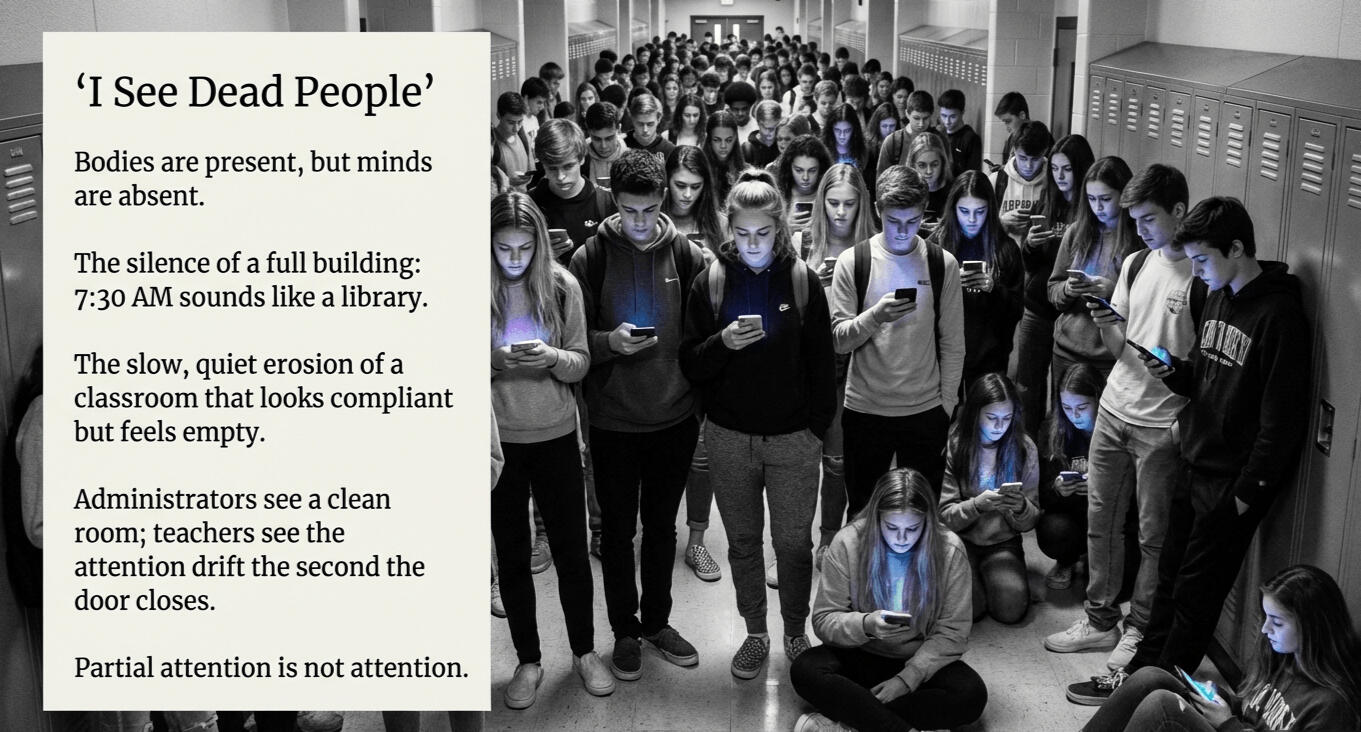
The Phone in the RoomThere is no issue more immediate, more visible, and more solvable than the presence of smartphones in schools.A smartphone is not a distraction in the way a passed note or a doodled notebook was a distraction. It is a portal. It connects the student to every relationship, every conflict, every piece of social drama, every notification, every algorithmically optimized feed designed by some of the most sophisticated engineers on earth to capture and hold human attention. When a student has a phone in their pocket, they are not fully in the classroom. They cannot be. The phone represents an entire competing world, and that world is engineered to win.I spent more than twenty years in the casino industry before I became a teacher. I know how attention capture works because I built a business around it. Slot machines use what psychologists call variable reward schedules. Sometimes the machine pays. Sometimes it does not. Sometimes it almost pays. That unpredictability keeps the brain locked in, because the next reward might be one pull away. The phone in a student's pocket runs on the exact same architecture. Every notification, every refresh, every vibration is a pull of the lever. And the phone never stops spinning.Schools that allow phones during instructional time are asking teachers to compete with systems designed by billion-dollar companies to be irresistible. That is not a fair fight. It is not a fight teachers should be asked to wage.And policies that ask students to simply put their phones away do not solve the problem. We call that approach self-carry, and it is based on the assumption that a student can carry a phone on their person all day and resist the urge to look at it. But here is the truth we need to say out loud: students cannot self-carry. They are not mature enough. And honestly, most adults are not either. The average adult checks their phone close to a hundred times a day. To expect a fifteen-year-old to outperform adults in resisting a device specifically designed to be irresistible is not a standard. It is a setup for failure.It is time to stop pretending otherwise. Phones need to be removed from students during school hours. Not managed. Not monitored. Removed.
- 12 -
This is not punitive. It is not anti-technology. It is not anti-student. It is a structural decision that says: for these hours, in this building, you are here. Fully here. Present with the people around you, engaged with the work in front of you, operating in shared reality rather than retreating into a private digital one.Every school that has made the decision to remove phones has seen the results. Students talk to each other again. Teachers can teach again. The room comes back to life. Every argument against phone removal has an answer, and chapter 2 that follows takes each one apart in detail.A school-wide phone ban during school hours is not the whole solution. But it is the first solution. It is the prerequisite for everything else this book argues for: genuine attention, shared presence, meaningful standards, and the restoration of the classroom as a place where real things happen between real people.The AI QuestionArtificial intelligence is not going away. This book does not argue that it should.Technology shifts create fear. They always have. I know this from experience. Early in my career, I sold emulation devices that allowed personal computers to connect to mainframes. Businesses resisted at first. The technology felt threatening. Eventually, integration happened, and the companies that adapted thrived. I watched this cycle play out over and over across decades in the technology industry. The genie does not go back in the bottle. The question has never been whether a new technology will arrive. The question is whether we integrate it without surrendering what matters.In schools, what matters is struggle. The cognitive effort of working through a problem, constructing an argument, revising a draft, failing and trying again. That is not an obstacle to learning. It is learning. When AI performs that work for the student, it does not assist education. It bypasses it. The student receives output without having built understanding. The assignment is complete, but nothing was learned.
- 13 -
The distinction schools need to draw is simple and enforceable. AI that supports effort is a tool. AI that replaces effort is a theft.Most people frame AI misuse the wrong way. They say the student cheated the teacher. They say the student cheated the school. But that is not what happened. The AI robbed the student. It took away the one thing the assignment was designed to build: their own capacity. The teacher still gets paid. The school still operates. The student is the one who lost something, and in most cases they do not even realize it yet.A calculator does not replace mathematical thinking. It extends it. Spell-check does not replace writing. It removes a mechanical barrier so the writer can focus on ideas. I know this personally. In 1984, in a small out of the way computer lab on the Lamar University Campus, the spell-check (F4 Key) on a 5 1/4 floppy disk containing the WordStar word processing program changed the trajectory of my life. I have dyslexia. I entered eighth grade reading at a third-grade level, battled and eventually attended college. Technology did not replace my thinking. It freed my thinking. That is the difference between a tool and a replacement. These are tools. They handle what the machine does better so the human can do what only the human can do.But AI that writes the essay, generates the analysis, produces the lab report, or completes the assignment without the student's cognitive engagement is not a tool. It is a replacement. And when replacement becomes the norm, the student never develops the capacity the assignment was designed to build. The eggs have been removed from the cake. The diploma still comes out of the oven, but the student did not make it.Schools need clear, specific, enforceable policies on AI use. Not blanket bans, which are unenforceable and send the wrong message. Not open adoption, which surrenders academic integrity. What they need are policies that draw the line at the point of cognitive effort: Did the student do the thinking? If yes, AI may have assisted. If no, AI replaced them. That is the standard.
- 14 -
Attendance Is StructuralIn any athletic program in the country, attendance is non-negotiable. You cannot skip practice and expect to play on Friday. You cannot lift weights only on game day. You cannot complete a virtual scrimmage. Practice at 4 PM on Monday is the expectation, and no parent, player, or administrator questions that.Nobody debates this. The reason nobody debates it is that everyone understands, intuitively, that physical presence is the prerequisite for everything else. You cannot develop as a player without being there. You cannot build trust with your teammates when you are gone. You cannot be coached by someone who is not in the same room with you.The classroom deserves the same structural logic.When attendance becomes optional, when a student can earn credit without being physically present, when online recovery replaces seat time, when graduation requires completion but not attendance, the institution loses its organizing principle. The teacher's authority erodes, because how can you hold a standard for someone who is not in the room? The classroom culture fractures, because shared experience requires shared presence. The diploma loses meaning, because it certifies completion without verifying investment.Two cultures are forming inside American schools right now. In one culture, families believe that showing up matters. They believe that physical presence, daily effort, and participation in the shared life of the school are essential. In the other culture, families believe that completion is enough. As long as the credits are earned and the boxes are checked, the method does not matter.Both cultures exist under the same roof. And when a student who attended every day walks across the same stage as a student who completed online recovery modules from a couch, the diploma is diluted for both. The serious student is demoralized. The teacher is undermined. The institution loses credibility. And the student that did not invest is not prepared for the world after graduation.
- 15 -
A Word to the People in the BuildingIf you are a teacher reading this, I need to say something directly. It is not your fault.The conditions you are working in were not created by you. The behaviors you are managing were not caused by you. You did not decide to let students carry phones all day. You did not design online credit recovery systems that allow students to earn diplomas without showing up. You did not adopt AI policies that are unclear, unenforceable, or nonexistent. You did not lower attendance standards. Those were structural decisions made by people with the authority to set policy. And when those decisions created exactly the dysfunction anyone with common sense could have predicted, the response was not to fix the policy. It was to send you to another training on how to cope with the consequences.Every training day carries the same unspoken message: if you were better at de-escalation, the behaviors would improve. If you were more resilient, the burnout would decrease. If you were more engaging, the students would pay attention. The finger always points downhill. It points at the people with the least power and the most exposure.This book does not point downhill. This book names the structural failures that created the conditions and argues for fixing them. The problems in your classroom trace back to decisions that were made above you. And the solutions require decisions that must be made above you. What you deserve is leadership that makes the hard calls instead of hiring another consultant to help you survive the consequences of their inaction.If you are an administrator reading this, I am not here to attack you. I am here to ask you to lead. The decisions this book calls for are not complicated. They are hard. There is a difference. Remove the phones. Enforce attendance. Set clear AI policies. Hold standards. These are simple sentences. Every one of them will cost you political capital, difficult conversations, and pushback from people who would rather keep things easy.
- 16 -
That is the cost of leadership. It has always been the cost of leadership. And it is worth paying, because the alternative is a building that looks like a school but has stopped functioning as one.If you are a parent reading this, I am asking you to be part of the solution. The changes this book proposes will make your child's life harder in the short term and better in the long term. A school-wide phone ban during school hours means your child will not have access to their social world for eight hours. Attendance standards mean fewer workarounds when mornings are hard. AI policies mean your child will have to do the thinking themselves. Those are real costs. What they save you is a child who actually learned something. A diploma your family can be proud of because your child earned it through real investment.A Framework for What Comes NextThe problems described in this introduction are not something that should be accepted because they are hard to manage and change. These problems are the result of structural decisions, and structural decisions can be changed. What follows is a framework built on three principles that have been tested, not in theory, but in classrooms, on practice fields, and in communities where standards still mean something.Responsibility. Showing up physically matters, and we say so clearly. Attendance is not a guideline. It is a requirement. Students are expected to be present, not because we are rigid, but because presence is the precondition for everything school is designed to do.Real rewards and consequences. Standards must mean something. Diplomas must cost something. Grades must reflect something. When a student meets a high standard, that achievement is recognized and valued. When a student does not meet the standard, the answer is not to lower the bar. The answer is to help them reach the bar, without pretending they already have.
- 17 -
Adults who neither rescue nor abandon. We do not make the bar easier to clear just because students have more ways to walk around it. And we do not give up on students who struggle to reach the bar. We hold the standard and we stay in the room. That combination, high expectations paired with persistent, present support, is the only formula that builds both competence and character.These are not new ideas. They are old ideas applied to a new problem. The simulation economy is new. The forces of AI, smartphones, and online recovery are new. But the human need for structure, effort, and the presence of adults who hold the line has not changed. It will not change.The Last Building StandingIn a culture optimized for simulation, avoidance, and frictionless completion, a place that still requires you to show up, put the phone away, do the work, and be present with other human beings is not outdated. It is essential.School is one of the last institutions in American life where this is still possible. Where a young person cannot curate their experience, cannot algorithm their way to comfort, cannot outsource the difficulty to a machine. Where they must sit in a room with people they did not choose, face expectations they did not set, and do work that does not come easily. And where an adult is there to hold them to it.That is not a burden. That is a gift. It is the one place left where reality still has to be faced rather than filtered.But it will not survive on autopilot. If schools attempt to coexist structurally with the simulation economy, if they allow phones to remain, if they let AI replace effort, if they award diplomas without presence, if they lower standards to accommodate avoidance, they will dilute their purpose until there is nothing left worth protecting.If schools choose instead to remain structurally different, to be the place that still demands something real, they can preserve what makes them irreplaceable. And on the other side of that decision is something worth fighting for. A hallway where students
- 18 -
look up from their phones and make eye contact. A classroom where the teacher has the room, fully, from bell to bell. A lunchroom where teenagers actually talk to each other. A graduation ceremony where every diploma on that stage represents something real, because every student who earned one was there, did the work, and struggled through it themselves.This book argues for the second path.Not because change is easy. Not because every family will agree. Not because the forces working against real schooling are weak. But because the alternative, letting schools become one more simulation in a world already drowning in simulations, is not something any serious educator, parent, or leader should accept.The price of building something real has always been high. That has never been a reason not to build it.I believe in respecting people's time. So I put everything upfront.Everything this book is about is in the pages you just read. If you stopped here, you would have enough to start a conversation in your school, your district, or your home about what needs to change and why.The point is this: schools are the last buildings standing in our communities. They are worth protecting. And protecting them requires decisions that are simple to name and hard to make. Remove the phones. Raise the standards. Require the presence. Integrate AI without surrendering struggle.The chapters that follow go deeper. Each one takes a single idea from this introduction and gives it the room to breathe, with stories, evidence, and practical implications. You can read them in order or pick the one that matters most to you right now.You don't need to read any part of the remainder of this book. You already have what you need.
- 19 -
Thank you for reading this far. In a world full of noise, the fact that you gave these pages your attention means something. I hope what you found here was worth it.End Chapter: Introduction - Administrative Duty and Safety Note
Schools have a duty to provide conditions where students are protected, teachers are supported, and learning is anchored in attention, presence, and real effort. When phones replace focus, AI replaces thinking, attendance loses meaning, and simulation replaces reality, the result is not innovation. It is a failure of structure that shifts risk onto students and staff.
- 20 -
A COACH’S NOTEThe Business of Behavior: Before We Hire Another Consultant
Before I became a teacher, I spent more than two decades in the business world. I ran companies. I managed people. I operated in one of the most heavily regulated industries in the country. And one of the things that experience taught me, the kind of lesson you cannot unlearn, is how to tell the difference between someone who is solving a problem and someone whose livelihood depends on the problem never being solved.I also learned something else. When things go wrong in an organization, the people at the top almost never blame themselves. They blame the people closest to the problem. In business, it is the frontline employees. In medicine, it is the nurses. In education, it is the teachers.I bring both of those lessons up because I want to be honest about something before this book begins.There is an industry built around the problems in American schools. It is large. It is profitable. And it is growing, because the problems are growing. Consultants, trainers, curriculum specialists, behavioral intervention companies, social-emotional learning platforms, trauma-informed practice certifications. The market for helping schools
- 21 -
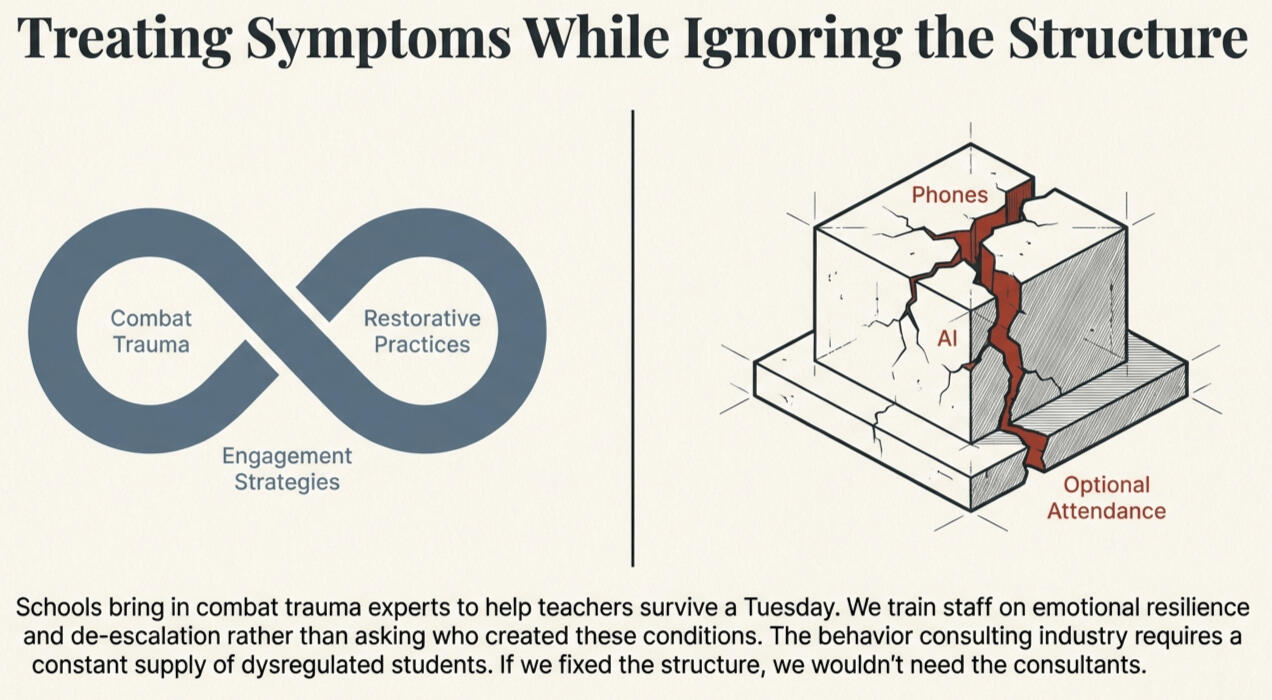
manage dysfunction is booming. And almost none of it is designed to fix what is actually broken.I have watched this from both sides now. As a businessman, I recognize the model. As a teacher, I live inside it.Three times a year, our school brings in consultants. They are part of a coordinated training effort, a triad of professionals who each address a different piece of what everyone agrees is a growing crisis. The first works with teachers on emotional resilience. The second teaches trauma-informed practices for managing student behavior. The third coaches classroom engagement strategies.All three are credentialed. All three are professional. All three care about the work. I am not questioning their character.I am questioning the model.The first consultant specializes in helping teachers stay emotionally intact. She comes from a military background, working with soldiers returning from combat zones, and she applies that same framework to our teaching staff. Let that settle for a moment. We are using techniques developed for men and women who survived armed conflict in foreign countries to help teachers get through a Tuesday in an American high school.On one level, there is something validating about that comparison. The emotional toll on teachers right now is real and it is severe. Teachers are not just tired. They are depleted. They are absorbing behaviors, hostility, and chaos that would have been unthinkable a generation ago, and they are doing it with fewer resources, less authority, and more scrutiny than at any point in the profession’s history.But step back and ask a harder question: why are we treating our classrooms like war zones? What is happening inside the building that has made the emotional experience of teaching so damaging that we need someone trained in combat trauma to help our staff survive it? And more importantly, who made the decisions that created these conditions?It was not the teachers.The teachers did not decide to let students carry phones all day. The teachers did not design online credit recovery systems that allow students to earn diplomas without showing up. The teachers did not adopt AI policies that are unclear, unenforceable, or
- 22 -
nonexistent. The teachers did not lower attendance standards. The teachers did not choose to prioritize graduation rates over actual learning.Those were structural decisions. They were made by administrators, school boards, district offices, and state legislatures. They were made by people with titles and authority and the power to set policy. And when those decisions created exactly the dysfunction anyone with common sense could have predicted, those same people did not look in the mirror. They looked at the teachers.This is the part that should make your blood boil if you are a teacher reading this.The board sets the policy. The superintendent implements it. The principal enforces it. And when the policy produces chaos, the training budget is spent on teaching you how to cope with the chaos. Not on fixing the policy. On fixing you. As if you are the problem.Every training day carries the same unspoken message: if you were better at de-escalation, the behaviors would improve. If you were more resilient, the burnout would decrease. If you were more engaging, the students would pay attention. The finger always points downhill. It points at the people with the least power and the most exposure.Teachers are the only professionals in America who are expected to manage the consequences of decisions they had no part in making, absorb the blame when those consequences materialize, and then sit through a training on how to do it better next time.A nurse does not get blamed for hospital infections caused by administrators who cut the cleaning budget. A soldier does not get blamed for a war started by politicians. But a teacher gets blamed every day for behaviors created by a system that has removed every structural support that made classrooms functional.That is not accountability. That is deflection. And it has been going on long enough that most people in education have stopped even noticing it.The first consultant helps teachers survive this dynamic. She does it well. But coping is not solving. Coping is what you do when the conditions do not change. And the conditions are not changing because the people with the power to change them keep hiring consultants instead.
- 23 -
The second consultant is the one who concerns me most. He teaches restorative practices. Trauma-informed instruction. De-escalation. How to reach students who have shut down, act out, or refuse to engage. On the surface, this sounds compassionate. It sounds like exactly what schools need. And that is what makes it so effective as a business model.Below the surface, his entire practice requires a constant supply of dysregulated students. If the root causes of the behavior were addressed, if phones were removed, if attendance were enforced, if standards were restored, his services would not be needed at the same scale. I am not saying he is aware of this. I am saying the incentive structure does not reward solutions. It rewards perpetuation.This is the same pattern you see in medicine, where a patient with chronic pain is prescribed a management regimen rather than offered a diagnosis. The doctor who manages your pain for twenty years bills twenty years of appointments. The doctor who finds the cause and fixes it bills once. Both are trained professionals. Both may have good intentions. But only one of them has a business model that depends on you staying sick.You see it in the technology industry, where software companies sell subscriptions to solve problems they could solve with a single update. You see it in home security, where the company that monitors your alarm system has no incentive to reduce crime in your neighborhood. And you see it in education, where an entire consulting industry has emerged around helping schools manage problems that the schools themselves created through structural neglect.The trauma-informed behavior consultant does not ask why there are so many traumatized students. He does not examine whether the school environment itself is contributing to the dysregulation. He does not suggest that maybe, just maybe, putting a device in every student’s pocket that connects them to social media, cyberbullying, algorithmic anxiety, and infinite distraction might have something to do with the behaviors he is being paid to address.He teaches teachers how to respond to the symptoms. The symptoms continue. He comes back. The cycle repeats.The third consultant in the triad I actually like. He is a skilled teacher. His strategies for keeping students engaged in learning are practical and useful. When he talks, I can see
- 24 -
my colleagues picking up techniques they will use the next day. He is the kind of educator who makes you better at your craft just by watching him work.But even he is working inside a framework that accepts the current conditions as fixed. He is teaching people how to be more engaging in a room full of students who have phones in their pockets, AI doing their homework, and no structural reason to invest in being there. He is trying to light a fire in a room where someone left all the windows open and winds keep blowing out the flames. His techniques work in the moment. But the moment ends, the windows are still open, and the fire goes out.I want to be clear about something. I am not angry at these three people. I am angry at a system that would rather pay outsiders to manage dysfunction than make the internal decisions that would eliminate it.Here is the pattern, and once you see it you cannot unsee it.The consultants arrive. They train. They leave. The conditions do not change. The behaviors continue. The teachers burn out. The consultants come back. Every four months, the same problems are addressed with new language, new frameworks, new acronyms. And every six months, nothing fundamental is different. The only thing that grows is the invoice.I have sat in enough of these training sessions to recognize what is happening. It is the same thing I saw in business when a company would hire a management consultant instead of making a hard decision. The consultant gave the leadership team something to point to. We are doing something. We brought in an expert. We are investing in our people. But the hard decision, the one that would actually fix the problem, the one that would cost political capital, the one that might upset someone or require some courage, that decision stays on the shelf.I know this because I have lived it. I have raised these issues in my own school. I have sat in the meetings. I have made the case for structural change to the people who have the authority to make it. The response has been polite, sometimes even encouraging. And then nothing changes. The consultants keep coming. The training days keep appearing on the calendar. And the hard decisions remain unmade. This book exists because I got tired of waiting for someone else to say what needed to be said.In our schools, the hard decisions are not mysterious. Remove the phones. Enforce attendance. Set clear AI policies. Hold standards. These are not complicated ideas. They
- 25 -
are simple, clear, and actionable. What they are not is easy. They require administrators to lead rather than accommodate. They require school boards to support their principals rather than cave to the loudest parent. They require superintendents to set policy based on what students need rather than what avoids conflict.And so instead of making those decisions, we hire another consultant. We schedule another training day. We ask teachers to learn another framework for managing the chaos that the people above them created and refuse to fix.I spent enough years in business to know what a self-perpetuating service model looks like. And I am watching one operate inside American education right now, funded by taxpayer dollars, endorsed by well-meaning administrators, and built on the backs of teachers who are too exhausted and too powerless to push back.This book is not about coping. It is not about managing behavior. It is not about helping teachers survive conditions that should not exist.This book is about fixing the conditions.Every behavioral challenge those consultants are hired to address traces back to the same structural failures. Students are disengaged because they have phones competing for their attention every second of every class. Teachers are burned out because they are being asked to hold standards in an environment that has quietly abandoned them. Students act out because the experience of school has become something they endure rather than something they invest in. Trauma-informed practices are necessary because we have created an environment that produces the trauma.Remove the phones. Restore the standards. Make attendance mean something. Draw a clear line on AI. Do those things and watch what happens to the behavior problems, the teacher burnout, and the engagement crisis. They will not disappear overnight. But they will begin to resolve, because you will have addressed what is actually causing them.The consultants are not the enemy. The model is. And the model persists because it is easier to buy training than to make hard structural decisions. It is easier to send teachers to a workshop on resilience than to remove the phones. It is easier to hire a behavior specialist than to enforce attendance. It is easier to learn engagement techniques than to require students to be present and invested.Easy has a cost. And the cost is that nothing changes.
- 26 -
If you are a teacher reading this, I want you to know something. It is not your fault. The conditions you are working in were not created by you. The behaviors you are managing were not caused by you. And the fact that someone keeps sending you to training instead of fixing the building around you is not a reflection of your failure. It is a reflection of theirs.This book is about the hard decisions. The ones that actually work. The ones that no consultant will ever recommend, because if those decisions were made, the consultants would not be needed.That is not a reason to avoid making them. That is the reason to develop and inpliment.I should probably tell you a little about who is writing this.I am not a career educator. I came to teaching late, and I came to it on purpose.When I was twenty-five years old, I moved from Texas to Colorado to help change the state constitution. The goal was to legalize gaming in three small mountain mining towns that were dying. I collected signatures. I learned how legislative campaigns worked. I did the ground-level work that most people never see. And when the governor signed the new law, I was standing behind him. Not because I was important. Because I had done the work.I applied for my gaming license during that process and was one of the first people in the state to receive one. Not because I was better at paperwork than anyone else, but because when you are twenty-five years old and investigators have to run a twenty-year background check, they end up talking to your first grade teacher. There was not much to investigate.On October 1, 1991, at the age of 26, I opened the first casino in Black Hawk, Colorado. Over the next two decades, I trained hundreds of employees. I ran operations in one of the most heavily regulated industries in the country, where mistakes are visible, compliance is non-negotiable, and accountability is not a slogan on a wall. It is how you keep your license.I have been the one making decisions. I have been the one responsible when those decisions went wrong. I have been the one protecting the people closest to the work, the
- 27 -
employees on the floor, the stakeholders counting on me, the community watching to see if I would do what I said I would do.
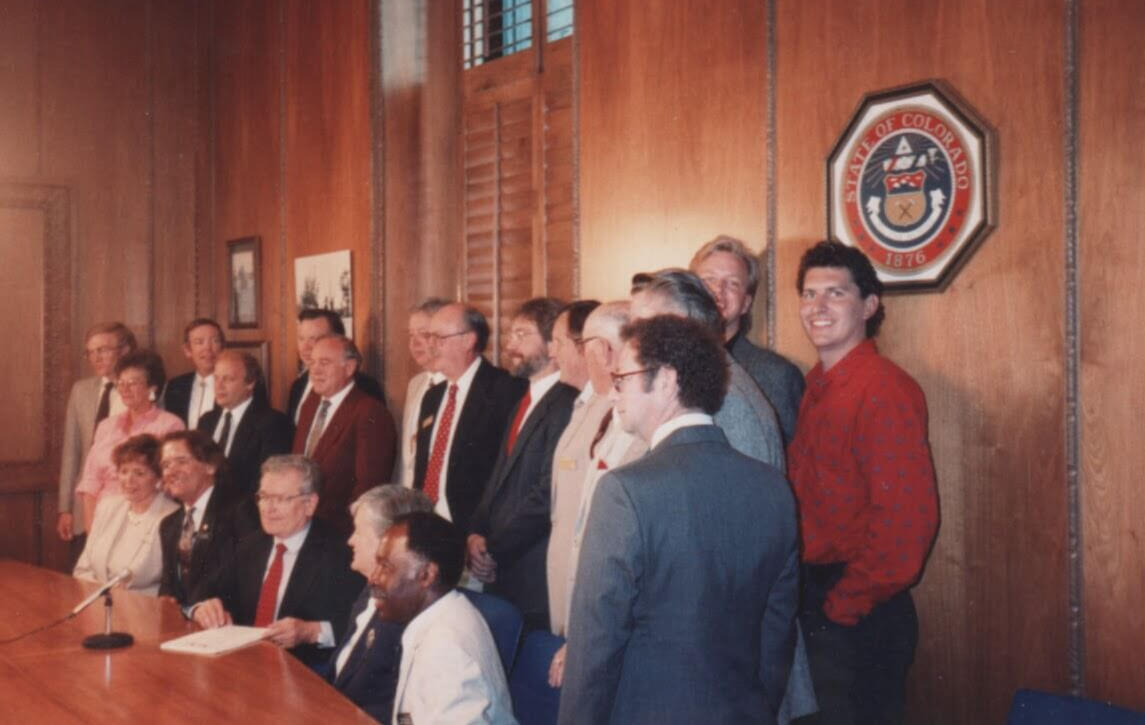
Coach Craig Ball (Red Shirt)- Age 26 May 1991 - The Colorado Governor's Office.
From Texas to Standing with the Governor in the highest office in the State within 2 years.
I left that world because of my kids. I wanted to be present for them in a way my career had not always allowed. Teaching and coaching gave me that. And the community that had supported me and my businesses for so many years had earned something in return. This was how I could give it back.But I did not expect what I found when I walked into the building.I watched a school system decay in ways that would never be tolerated in any business I ever ran. I watched structural problems get ignored while the people closest to the work absorbed all the consequences. Those in power didn’t protect the front line teachers; they opened the flood gates and told the teachers to clean up the mess. I watched leaders avoid hard decisions and blame the people who had no power to make them. And I recognized the pattern, because I had spent my whole career learning to spot it.
- 28 -
I am tired of sitting on the sideline. I care about my school. I care about the teachers who show up every day and give everything they have to a system that does not protect them. I care about the families who trust us with their children. I care about the students who deserve better than what we are giving them right now.I am here to solve a problem. That is what I do. That is what this book is about.End Chapter: Coach’s Note - Administrative Duty and Safety Note
The concerns raised in this book are not personal grievances. They are structural concerns tied to the responsibility schools have to protect students, support teachers, and maintain order. When adults in a building see repeated breakdowns and say nothing, risk grows for everyone.
- 29 -

Chapter 1
"You Can't Handle the Truth"
The Cake Needed Eggs
Chapter GuideThis section appears at the beginning of every chapter. If you have read it before, skip ahead to the chapter content below. If this is your first chapter, take a minute with it. It frames how the entire book works.The problems facing in-person education today are big. They are connected. And they will not be solved by one person acting alone. Every large, meaningful problem follows the same path to a solution:
- 30 -
Identify the problem. Some problems are easy to see. The hardest ones hide underneath the obvious, feeding every visible issue while staying out of sight.Frame it so others can see it too. A problem you understand but cannot explain to others is a problem you will solve alone. And you cannot solve this one alone. You are going to need a bigger boat.Build a plan with clear first steps. You will never have the complete plan before you start. If you wait for that, you will stall. Get the first steps right and adjust as you learn.Execute and iterate. If something is not getting you closer to the goal, change it. Above all, keep pushing forward. This is the hardest part. My dad always said that if you bite off more than you can chew, you only have two choices: start chewing or spit it out. Quitting has never solved a real problem.This book follows that framework. Each chapter identifies a piece of the problem, frames it clearly enough to bring others along, and points toward action. The solutions in this book require teachers, administrators, and parents pulling in the same direction. That will only happen when the problem is framed well enough that everyone in the community understands what is at stake and why it matters.That is what this book is for. It is the framing. It is the building of a bigger boat.Here is where this chapter fits:This chapter identifies the hidden problem. Phones in classrooms, chronic absenteeism, and unregulated AI use are the problems everyone can see. They fill up faculty meetings and school board agendas. But all three of them do the same thing. They remove investment from the educational experience. When effort disappears from the process, ownership disappears with it. A student who is not investing attention, presence, and genuine work into their education will not value the result. That is the problem underneath all the other problems. Until we name it clearly, we will keep treating each issue separately and wondering why nothing changes.
- 31 -
A Cake That Was Too EasyIn the 1950s, General Mills launched a line of Betty Crocker cake mixes that should have changed everything. The mix contained all the ingredients: flour, sugar, powdered milk, and powdered eggs. All a baker needed to add was water. Stir, pour, bake. A perfect cake with almost no effort.It should have been the most popular product on the shelf. It was not. Despite the time savings, despite the convenience, despite the trusted Betty Crocker brand on the box, the mixes did not sell.General Mills brought in Ernest Dichter, a consumer psychologist, to figure out why. Dichter interviewed women across the country and came back with an answer that surprised the company. The problem was not the taste. It was not the price. It was not the packaging. The problem was that making the cake felt like cheating. The process was so effortless that the person baking it had no sense of ownership over the result. It did not feel like their cake. It felt like the box's cake. They could not serve it with pride because they had not put anything of themselves into it.What happened next went against every instinct in product development. Instead of keeping the mix easy, General Mills made it harder. They removed the powdered eggs and required bakers to crack in their own fresh eggs, add oil, and mix by hand. The new version required more work. It was less convenient. It took more time.Sales took off.Now, the full history is more nuanced than the clean version of the base story above. Fresh eggs also produced a better-tasting cake. And the broader marketing shift toward encouraging bakers to frost and decorate their creations with personal flair played a real role in driving adoption and sales vertically. Historians have rightly pointed out that the egg alone did not save the product.
- 32 -
But here is what matters for us. Every piece of that fuller story reinforces the same lesson. Whether it was the egg, the frosting, or the creative decoration, the thing that changed was investment. People were putting something of themselves into the process. And that investment changed how they felt about the result. They could bring that cake to a church potluck or a birthday party and say, with real pride, that they made it.The cake needed eggs. Not because eggs were the secret ingredient in the recipe. Because effort was the secret ingredient in the experience.Why This Matters to Your FamilyIf you are a parent reading this, you might be wondering what a cake mix story from the 1950s has to do with your child's school. Here is the connection, and it is not abstract.Every day, your child walks into a building and spends hours of their life there. The question is whether that time costs them something real or whether it is just something they pass through. Not cost in dollars. Cost in effort. Cost in attention. Cost in doing things that are hard and sticking with them anyway.When your child has to put their phone away for the school day, that costs them something. They lose access to their social world, their entertainment, their constant connection to everything outside that building. That is inconvenient. It is also the point. That inconvenience is the egg in the cake. It is what makes the school day theirs, because they had to be fully present for it.When your child has to show up, physically, day after day, even on the days they do not want to, that costs them something. Getting out of bed when it is dark. Sitting through a class that does not come easily. Being in a room with people they did not choose. That friction is not a flaw in the system. It is the system working. Those are the eggs.When your child has to write the paper themselves, think through the problem themselves, and struggle with material that does not come easily, that costs them something. It would be faster and easier to let a machine do it. But faster and easier is the just-add-water version. It produces a product that looks right but means nothing.
- 33 -
Every parent wants their child to succeed. The question is whether we define success as getting through with the least resistance or as building something that actually belongs to them. A diploma that cost your child real effort, real presence, and real attention is a diploma your child owns. A diploma that was earned through workarounds and shortcuts is a piece of paper.The schools that hold these standards are not making your child's life harder for the sake of it. They are making sure the experience means something by the time it is over.This Is Not Just a Story. It Is Science.What Ernest Dichter discovered through interviews in the 1950s, researchers have since confirmed and expanded in controlled studies. The connection between effort and value is not a feel-good idea. It is one of the most well-documented patterns in behavioral science.In 2011, a research team from Harvard, Yale, and Duke published a landmark study that gave this phenomenon a name: the IKEA effect. The finding was straightforward. People place a disproportionately high value on things they helped create, even when the things they created are objectively worse than a professionally made version. In one experiment, participants who assembled simple furniture were willing to pay 63% more for what they built than people who were shown identical pre-assembled versions. Same furniture. Same materials. The only difference was effort. And that effort changed how people valued the result.The researchers pushed further with an origami experiment. They asked one group to fold paper cranes and frogs, and a second group to simply look at the finished products. The results were striking. The people who folded their own paper cranes valued their clumsy, crooked creations at nearly five times the rate of the people who just looked at them. The builders even rated their amateur work almost as highly as expert-made origami. The labor itself had fundamentally changed perception. Not the quality of the output. The effort of the input.
- 34 -
But the most important finding for education came from a different part of the study. The researchers discovered that the effect only held when the work led to successful completion. When participants built something and then watched it get taken apart, or when they could not finish what they started, the extra value disappeared entirely. Effort alone was not enough. The effort had to lead to something the person could look at and say: I did that. I finished it. It is mine.Think about what that means for a school. A student who shows up every day, does the reading, works through the math, writes and rewrites the paper, and walks across the stage at graduation has cracked every egg in the recipe. That diploma means something to that student because it cost something. Not just tuition or time. Real personal investment.A student who missed large stretches of the year, completed an online credit recovery module from a couch, and walked across the same stage did not make that investment. The diploma looks the same. The ceremony is the same. But the experience behind it is completely different. One student built the cake. The other added water.As a parent, ask yourself: which version do you want for your child? The one that holds a diploma that has no value? Or the diploma that can be held as proof of work?Struggle Is Where Learning LivesThe IKEA effect explains why we value what we build. But there is a deeper question for anyone who cares about education: does struggle itself produce better learning? Not just more pride in the result, but a genuinely deeper understanding of the material?The answer, backed by two decades of research across thousands of students, is yes.Manu Kapur, a learning scientist at ETH Zurich in Switzerland, has spent his career studying what he calls productive failure. His approach flips traditional instruction on its head. Instead of teaching a concept first and then asking students to practice, he gives students a problem they do not yet know how to solve and lets them struggle with it before any teaching happens. The students fail. They generate wrong answers. They
- 35 -
hit dead ends. They get frustrated. And then, when the instruction comes, they learn the material at a significantly deeper level than students who were taught the conventional way.This is not a minor difference. Kapur's meta-analysis across 53 studies and more than 12,000 students found that this approach produced effects on conceptual understanding and knowledge transfer nearly twice as large as what a student typically gains from a full year with a good teacher. The students who struggled first did not just score higher on a test. They understood the ideas more deeply and could apply them to problems they had never seen before. The struggle was not an obstacle to their learning. It was the mechanism that made the learning stick.Other researchers have confirmed this from different angles. Albert Bandura's foundational work on self-efficacy found that successful completion of difficult tasks is the single most powerful builder of lasting confidence. Not praise. Not encouragement. Not lowered expectations. Actually doing something hard and finishing it. Jo Boaler at Stanford has demonstrated that when students engage in productive struggle in mathematics, measurable changes occur in their brains. The neural pathways associated with problem-solving and conceptual thinking grow stronger. The struggle changes the brain itself.Here is the part that matters most for parents. This research consistently shows that struggle has to be real. It cannot be performed. It cannot be simulated. It cannot be outsourced to a machine. The student has to be the one doing the hard thing. When we hand a student a shortcut that removes the difficulty, we are not helping them. We are taking away the very experience that would have made them stronger, smarter, and more capable.Every parent has watched their child struggle with something hard. Homework that did not make sense. A test they were not ready for. A project that felt overwhelming. The instinct to step in and remove the difficulty is natural. It comes from love. But the research is clear: the difficulty is doing the work. Not the kind of difficulty that overwhelms and defeats a student. The kind that challenges them just beyond what they
- 36 -
can do easily, with a teacher in the room who supports them without rescuing them. That is the space where learning actually happens.Three Problems, One OutcomeSchools across the country are dealing with three problems that dominate every faculty meeting, every board presentation, and every parent conference. Phone use in classrooms. Chronic absenteeism. Students using AI to do their work for them. They get discussed separately. They get addressed with separate policies. They show up in different line items on the improvement plan.But they are not separate problems. They all do the same thing. They remove investment from the educational experience. They take the eggs out of the cake.Phones remove attention. A phone in a student's pocket is not a distraction in the way a note passed in class was a distraction in 1995. It is a portal to every relationship, every conflict, every piece of entertainment, and every identity that a student maintains outside the school building. When it is accessible, the student's attention is divided at best and absent at worst. Partial attention is not attention. A student scrolling under a desk during a lesson is physically present but has not invested their mind in the room. They are adding water. The eggs are still in the carton.You might ask, as a parent: why can't my child just learn self-control? Why does the school have to take the phone? The answer is that we are not asking children to resist a minor temptation. We are asking them to ignore a device that has been engineered by some of the most well-funded companies on earth to capture and hold human attention. Adults cannot consistently resist it. We check our phones 80 to 100 times a day on average. We reach for them in meetings, at dinner, at stoplights. To expect a fifteen-year-old to outperform adults in resisting a tool specifically designed to be irresistible is not a standard. It is a setup for failure. Removing the phone from the equation is not a punishment. It is an acknowledgment of reality.Chronic absence removes presence. When a student can miss weeks of school and still earn a diploma through an online credit recovery program, the school has sent a
- 37 -
clear message: showing up is optional. The credits are what matter, not the experience. This might sound reasonable in the abstract. Credits earned are credits earned, right?But think about what is actually lost. The student who is absent misses the class discussion where an idea clicked for the first time. They miss the group project where they had to work with someone they did not like and figure it out anyway. They miss the teacher who noticed they were struggling and pulled them aside. They miss the daily, grinding, ordinary experience of being in a room with other human beings and doing something hard together. None of that can be recovered in a module.More importantly, the students who did show up every day are watching. They see a classmate walk across the same stage at graduation who was not there for most of the journey. And they learn a lesson we did not intend to teach: the effort was optional. Showing up did not actually matter. The school said it mattered, but the policy said otherwise. That lesson does more damage to a school's credibility than any test score.Unregulated AI removes the work itself. When a student can paste a prompt into a chatbot and receive a finished essay in thirty seconds, the effort has been transferred entirely. The student did not wrestle with the structure. They did not struggle to find the right word. They did not revise their argument three times before it started to make sense. The productive failure that would have deepened their understanding never happened.The essay might be technically solid. It might even be better than what the student would have written on their own. But that misses the point completely. The value of writing the essay was never the essay. It was the thinking that happened during the writing. The struggle to organize an argument is what teaches a student how to think clearly. Take away the struggle and you take away the learning. The cake came out of the box looking perfect, and the student learned nothing from making it.As a parent, you might think: my child is smart enough to use these tools responsibly. Maybe they are. But responsible use of AI in education means using it to support effort, not replace it. A calculator extends mathematical thinking. A chatbot that writes the
- 38 -
paper eliminates the thinking entirely. Schools need clear policies that draw that line, and students need adults who hold it.These three problems are not three separate fights. They are the same fight. Phones, absence, and AI all do the same thing to the educational experience: they remove the investment. They take out the eggs. And without the eggs, the cake does not belong to the student anymore. It is just something that happened to them, not something they built.Putting the Eggs Back InGeneral Mills solved their problem in the 1950s. They did not launch a marketing campaign to convince customers the easy version was fine. They did not blame customers for not appreciating convenience. They changed the product. They put the effort back in, and people responded.That is what we have to do in our schools. And when I say we, I mean all of us. Teachers, administrators, and parents. This is not something a principal can fix with a memo. It is not something a school board can solve with a policy vote. It requires a shared understanding across the community that investment is not an obstacle to education. It is education.A school-wide phone ban during school hours is putting the eggs back in. It restores the conditions under which attention, and therefore learning, can happen. When the phone is gone, the student's full presence is in the room. Not their body in one place and their mind in another. Their whole self. That is the investment that makes the time count.Enforcing meaningful attendance standards is putting the eggs back in. It is the decision, made together by schools and families, that showing up matters. That being in a classroom with a teacher and other students is not interchangeable with clicking through a screen at midnight. That the diploma your child receives represents something they actually did, day after day, in a real place, alongside real people.
- 39 -
Creating clear, enforceable AI policies is putting the eggs back in. It means drawing a bright line between AI that supports a student's effort and AI that replaces it. Using AI to check grammar, find sources, or explore ideas before writing is extending the work. Using AI to generate the final product is skipping the work. Schools need policies that are specific enough to enforce and rooted in a principle parents can understand: if the student did not do the thinking, the student did not do the assignment.None of this is easy to implement. If it were easy, it would already be done.The StandardThe Betty Crocker story is not a business case study. It is a human one. It tells us something fundamental about the way people, all people, assign value to their experiences. We value what costs us something. We take ownership of what we invest in. We remember what we struggled to build.This is not a theory. It is how human beings are wired. The IKEA effect proved it in the lab. Productive failure research proved it in the classroom. And every coach, every teacher, and every parent who has ever watched a child push through something hard and come out the other side stronger has seen it with their own eyes.Every policy decision a school makes either adds eggs to the cake or takes them out. Every time we make it easier for students to earn a credential without investing real effort, real presence, and real attention, we are removing the eggs and asking them to just add water. Every time we hold a standard that requires students to actually be there, do the work, and struggle through the hard parts, we are putting the eggs back in.Ownership requires effort. Effort creates buy-in. Friction builds meaning.The cake needed eggs. So does the education.What It CostsThis book does not pretend that raising standards is free. Every change this book proposes comes with real costs, practical and financial, for everyone involved. If we are
- 40 -
going to ask a community to do hard things, we owe them honesty about what those hard things actually cost. This chapter addresses all three problems broadly. Later chapters will break down the specific costs of each in detail.The Cost to ParentsA school-wide phone ban means your child will not be reachable by text during the school day. For some families, that feels like a safety issue. It is not, and later chapters will address emergency communication directly. But the discomfort is real. You will need to trust the school to handle the hours between drop-off and pick-up without a direct line to your child's pocket. That is a shift, and it requires a relationship with the school built on communication and transparency.Meaningful attendance standards mean fewer workarounds when life gets complicated. When a family vacation overlaps with the school calendar, the school will not pretend those days do not matter. When a student wants to stay home because they are tired, or anxious, or just not feeling it, the expectation will be that they come anyway. That puts pressure on parents to prioritize school attendance in ways that are sometimes inconvenient. It may mean harder mornings. It may mean saying no to things that feel reasonable in the moment.AI policies mean your child may come home frustrated that they cannot use a tool their friends at another school are using freely. You will hear about it. You may need to explain, more than once, why the harder path is the better one. That is not a fun conversation. It is an important one.What it saves you is a child who actually learned something. A diploma your family can be proud of because your child earned it through real investment. And the knowledge that when your child enters the workforce or a college classroom, they have the skills, the discipline, and the resilience that come from doing hard things over a sustained period of time. No shortcut builds that.
- 41 -
The Cost to AdministratorsA school-wide phone ban requires infrastructure. Whether it is locking pouches, collection systems at the door, or secured storage, there is a financial cost to implementation. Vendors sell phone pouch systems, and they are not free. There is also a policy cost: writing the rules, communicating them to families, training staff to enforce them consistently, and handling the inevitable pushback from parents who disagree.Attendance enforcement means standing behind a standard that some families will challenge. It means potentially lower graduation rates in the short term as credit recovery becomes harder to use as a workaround. That is a difficult number to defend at a school board meeting, even when the long-term credibility of the diploma depends on it. Administrators will face pressure from families, from district leadership, and from a culture that increasingly treats completion as more important than presence.AI policy requires staying ahead of technology that changes faster than most policy cycles. It requires investing in professional development so teachers understand the tools well enough to know when a student is using them appropriately and when they are not. It requires being willing to update guidelines regularly and to admit that the first version of any AI policy will need revision.The political capital required is significant. An administrator who implements these changes will receive phone calls, attend difficult meetings, and face criticism from people who feel the school is being too strict. That is the cost. What it saves is institutional credibility. A school that holds meaningful standards attracts and retains better teachers. It builds trust with the families who care most about the quality of the education. And it produces graduates that employers and colleges take seriously because the diploma actually represents something.The Cost to TeachersTeachers will bear the daily enforcement burden of every policy this book proposes. A school-wide phone ban means managing the transition at the start of each day, handling
- 42 -
students who try to keep their devices, and navigating the occasional confrontation. That is real time and real energy added to a job that already demands both.Attendance standards mean more documentation, more communication with families about absences, and more effort to support students who are struggling to be present. Teachers will need to hold the line on what counts as participation, even when it would be easier to let a student slide by with minimal engagement.AI policy means learning enough about the technology to recognize when a student's work was generated rather than written. It means redesigning some assignments to be harder to outsource. It means having conversations with students about integrity that are more nuanced and more frequent than the old plagiarism talk. All of this takes time, training, and support from administration.What it saves teachers is something money cannot buy: a classroom full of students who are actually there. Not just physically present, but mentally invested. Teachers entered this profession to teach. The costs described here are the cost of getting to do that job the way it was meant to be done. Engaged students, real learning, and the professional dignity of holding a standard that means something.The Cost to StudentsStudents will feel these changes the most immediately and complain about them the loudest. Giving up a phone for the school day feels, to a teenager, like losing a limb. Their social life, their entertainment, their sense of connection to the world outside the building, all of it goes into a pouch or a locker for seven hours. That is a real sacrifice from a student's perspective, and dismissing it does not help. It is real to them.Attendance standards mean showing up on days when every part of them wants to stay home. It means being in a classroom at 8 AM when they are tired, distracted, or going through something hard in their personal life. It means not having the option to check out and catch up later through a screen.AI restrictions mean doing work that takes longer and feels harder than it has to. A student who knows a chatbot could write their essay in thirty seconds and chooses to
- 43 -
spend two hours writing it themselves is making a choice that does not feel fair in the moment. That tension is real, and it will not go away.But here is the other side of the ledger. A student who goes through school without these standards graduates with a piece of paper and very little else. They have not built the habit of sustained attention. They have not developed the resilience that comes from showing up when it is hard. They have not experienced the productive struggle that builds genuine understanding. They walk out the door with a credential and no capacity. The world they are about to enter does not care about the credential. It cares about what the person behind it can actually do.The student who paid the cost, who showed up, put the phone away, and did the work themselves, walks out with something different. Not just a diploma, but the proof that they can do hard things. That proof lives inside them. No one can take it away, and no shortcut can build it.The cost is real for everyone. This book does not pretend otherwise. But the cost of doing nothing is higher. It is a school system that produces graduates who own nothing they were given, because they were never asked to invest in earning it.THE COMMUNITY COSTTeachers cannot hold this standard without administrators who back them up. Administrators cannot hold it without parents who support the policy at home. Parents cannot demand a meaningful education for their children if the school has already decided it is easier to lower the bar. And none of it matters if students walk through the door every day into a building where no one expects anything real from them.This is not a teacher problem, an administration problem, or a parent problem. It is a community problem. And the cost of solving it is a community cost.That cost looks different for each group. The previous section in this chapter laid out the specifics. But the price we all share is this: we have to choose the harder path when the easier one is available. We have to say, together, that the standard matters more than
- 44 -
convenience. That investment matters more than completion. That what our students become matters more than what they receive.No one in this community gets to sit this out. The administrator who holds the standard but gets no support from parents will eventually stop holding it. The teacher who enforces the policy but gets overruled by the front office will stop enforcing it. The parent who believes in the standard but watches the school abandon it will lose trust. The system only works when everyone pays in. That is the community cost. Not one person's sacrifice. A shared investment.The problems in this book are solvable. But they require a coalition. Teachers, administrators, and parents pulling in the same direction, for the same reason, at the same time. That is the bigger boat. And the only way to build it is together.In Chapter 2 we talk about Phones in the School.End Chapter: Chapter 1 - Administrative Duty and Safety Note
Schools have a duty to preserve the role of effort in learning because struggle, practice, and participation are part of how students grow in judgment, resilience, and responsibility. When schools remove the need for effort, they do not make students safer or stronger. They leave them less prepared for reality and teachers less able to uphold meaningful standards.
- 45 -
Chapter 2
"I See Dead People"
The Phone in the Room
Chapter GuideThis book follows a framework. If you have read the introduction or any previous chapter, you have already seen it. If you picked up this chapter on its own, here it is.The problems facing in-person education today are big. They are connected. And they will not be solved by one person acting alone. Every large, meaningful problem follows the same path to a solution.Identify the problem. Some problems are easy to see. The hardest ones hide underneath the obvious, feeding every visible issue while staying out of sight.Frame it so others can see it too. A problem you understand but cannot explain to others is a problem you will solve alone. And you cannot solve this one alone. You are going to need a bigger boat.Build a plan with clear first steps. You will never have the complete plan before you start. If you wait for that, you will stall. Get the first steps right and adjust as you learn.
- 46 -
Execute and iterate. If something is not getting you closer to the goal, change it. Above all, keep pushing forward. This is the hardest part. My dad always said that if you bite off more than you can chew, you only have two choices: start chewing or spit it out. Quitting has never solved a real problem.This chapter applies that framework to the most visible, most immediate, and most solvable problem in American schools today: the smartphone.The problem is not hard to identify. Every teacher in the country can describe it. The challenge is framing it clearly enough that parents, administrators, and school boards see it the way teachers do. Because right now, most people outside the classroom do not understand what is actually happening inside our schools.They have a hard time seeing it. The phone's impact is hidden in plan site. You don’t see the kids in the hallways. You don’t see our lunchrooms. How can those in the community see our time before school or how could they imagine what the bathrooms have turned into?So let me show you.The Parent Walk-ThroughImagine you are a parent. Your child’s school invites you to spend a morning. You are there just to see how everything works. You want to see what a normal day looks like. You arrive when the doors open at 7:30a.The first thing you notice is the silence as the atrium starts to fill.The building is full of kids. Students are everywhere. They are sitting in the commons, leaning against walls, gathered in clusters near their lockers. But almost no one is talking. Almost every head bowed down. Almost every pair of eyes is locked on a screen.The thirty minutes before school starts, in a building full of teenagers, and the room sounds like a library. The students are not being told to be quiet. It’s because the phones have them. Secure in the grip of their phone.You watch for a few minutes. Two friends are sitting next to each other on a bench, each scrolling separately. A group of four students stands in a loose circle, but no one is looking up. One of them laughs at something on their screen. Nobody else reacts. They are physically together and completely alone.
- 47 -
I see this every morning. I work the door and welcome every student who walks in. I make eye contact, say good morning, and try to get a response. It is something I have done my entire career, long before I became a teacher. When I ran casinos, I trained every employee on what we called the three-foot rule. If anyone comes within three feet of you, you look up, you make eye contact, and you acknowledge them. It was not optional. It was how we built a culture of connection in a building full of strangers.I still use that rule today. Every morning at the door. Every pass through the hallway. Every time I see a student. I look up and make eye contact. I say something. It is one of the simplest things an adult can model for a young person, and one of the most important.But at 7:55a, when I need students to put their phones away and get to class, I am fighting for their attention against a device that has held it for the last half hour. The students do not want to let go. They are somehow comfortable just sitting there. Some of them barely look up. Getting them out of that trance and into a classroom ready to learn is like pulling someone out of a current. It takes more effort than it should. It happens every single morning.Now imagine you follow one of those students to class. You take a seat in the back of the room and watch.The teacher has just started her lesson. The lesson took real planning to build. The board is covered in steps. A few students are following along. A few are catching up. The room has a rhythm to it.Then something happens. It is so small you almost miss it. One student shifts in their chair and glances down. The phone stays under the desk. A quick check. Maybe just 6 seconds. Across the room, another student sees the movement. Their eyes leave the board too. A few seconds later the teacher asks a question. Silence. The teacher rewinds and starts again.Five minutes later it happens again. Another vibration. Another glance. Another student disappears into a screen just long enough to lose the thread of the lesson.From the back of the room, you would not see anything dramatic. No disruption. No loud talking. No open defiance. Just a room that slowly empties out while every seat stays full.At lunch, you see the same thing. The cafeteria is full of students eating with their heads down. Some tables have ten kids sitting together, and half of them are on their phones. The conversations that do happen are short, interrupted, half-present. The lunchroom should be the loudest, most social thirty minutes of the day. Instead, it feels like a waiting room.
- 48 -
In the hallways between classes, students walk with their phones in front of them. They do not look where they are going. They bump into each other. They walk past teachers without making eye contact. They are zombies moving between rooms, transfixed on a screen for the three minutes of freedom the passing period gives them.That is a full day at a school with self-carried phones.The students are there. You can see them. They are sitting in their chairs, walking through the halls, eating in the cafeteria. But their attention has left the building. Their minds are somewhere else. They are physically present and mentally gone.“I see dead people”In the movie, the kid could see what no one else could see. People who looked alive but were not. That is what a school with self-carried phones looks like to a teacher who pays attention. The students are in the building, but they are not in the building. Their bodies showed up. Their attention did not.And the hardest part is this: nothing went wrong. No one got in trouble, no enforcable rule was broken. The teacher kept teaching. The students kept sitting. But learning left the room, and most people watching from the outside would never know it happened.The Slot Machine in Their PocketBefore I became a teacher, I spent more than two decades in the casino industry. I opened the first casino in Black Hawk, Colorado, when I was twenty-six years old. I trained hundreds of employees and operated in one of the most tightly regulated industries in the country.Running a casino teaches you something most people never think about. It teaches you how human attention works.Casinos are not built around luck. They are built around psychology. Every light, every sound, every reward schedule inside a casino is carefully engineered to hold a person’s attention just a little longer. Slot machines do not simply pay out randomly. They use what behavioral psychologists call variable reward schedules. Sometimes the machine pays quickly. Sometimes it waits. Sometimes it almost pays. That unpredictability keeps the brain engaged because the next reward might be just one pull away.If the reward came every single time, the brain would lose interest. If the reward never came, the brain would give up. The magic zone is uncertainty. That is where attention locks in.
- 49 -
The device sitting in a student’s pocket runs on the exact same architecture. Every notification, every vibration, every refresh of a social media feed is a tiny pull of the lever. Sometimes there is nothing there. Sometimes there is a message. Sometimes there is a like, a comment, a video, or a piece of drama happening somewhere in their social world. The reward is unpredictable. Which means the brain keeps checking.The average adult checks their phone close to a hundred times a day. That is roughly once every ten minutes during waking hours. And that is adults with fully developed impulse control.Now imagine asking a fifteen-year-old to sit in a classroom with that machine in their pocket and simply ignore it.That is what schools across the country are doing every day. We call it self-carry.What Self-Carry Actually Looks LikeSelf-carry sounds reasonable. Students keep their phones on their person but are not allowed to use them during class. Keep it in your pocket. Pay attention. If a teacher sees it, you will be asked to put it away.On paper, in theory, this works. In practice, it does not.I work in a school where the phone policy is clear. No phone use during classroom periods. The rule is posted, explained, and enforced. The students know it. Most of them are compliant. These are good kids in a good school with a reasonable policy.And it still does not work.Here is what I have found. When I ask teachers how the phone policy is going in their classroom, the answer is almost always the same. “Great. My kids don’t really use their phones during class.” And I know, because I have watched it happen over and over, that they are kidding themselves.It is not that they are bad teachers. In fact it is the opposite. They are good teachers being reasonable. They are being the kind of caring, helpful adults that students need in a room. And that is exactly what the phone exploits.A student needs to text a parent. Of course you let them, a parent needs to communicate with their kids at all times. A student says they need the calculator app. Just real quick, of course. A group of students is organizing for a basketball game they are leaving for next period. I need to snap the group. Sure, go ahead. A student says they are checking an assignment on Google Classroom. Makes sense. A student has the phone out to look
- 50 -
up something really quick for the lesson. Why would you say no? Teachers let students take a quick photo of the board or notes to help with homework. How could that be a problem?Each one of those moments seems small. Each one seems reasonable. And each one opens the door just enough for the device to do what it was designed to do. Because the phone does not stay on the calculator. It does not stay on the text to the parent. It drifts. It always drifts. One check becomes two. One minute becomes five. And the teacher, who was being a reasonable and loving adult, has just lost a piece of the room without even realizing it.This is what the technology companies are counting on. They know teachers are not tyrants. They know teachers want to be helpful. They know that a caring adult in a room full of teenagers will always lean toward saying yes. And they have designed their products to take advantage of that instinct. Every exception, every reasonable accommodation, every moment a teacher opens the door just a crack, the phone walks through it.This happens everyday and it is not a failure of teaching. That is a system designed to exploit the best instincts of the people in the room. It is calculated. It is deliberate. And it is sinister.Snapchat Is Bigger Than You ThinkI need to tell you something that most parents and administrators do not know. And it starts with a number. 2.3 million.I have used Snapchat since July of 2016, when my son was sixteen and we sent our first snap together. Over the years, I used the platform as my primary communication tool for my football team and my track team for about six seasons before my school switched to a protected in-house messaging system. I used it because it worked. When you sent a snap to your team, you knew they were going to read it immediately. For communicating with young people, it was the most effective system I have ever used.I am telling you this because I want you to understand that I am not a casual user. I have used Snapchat everyday for 10 years, as an adult, for real communication. I recently crossed the 50,000 Snapchat score threshold. That score tracks how many snaps you have sent and received over your entire time on the platform. Fifty thousand. That is a lot of snaps for an adult with a job, a family, and a life outside his phone.Now let me tell you what I found out about my students.
- 51 -
I teach a computer class where students learn Excel programming. One of the early lessons uses a shared sheet casted to the TV. I use it to get to know my students while they learn how to work with cells and formulas. I ask questions like, do you have a pet, are you Xbox or PlayStation, what is your favorite social media platform. They each fill out the sheet for all to see. One of the questions I always include is their Snapchat score.The first time I collected the data, I did not know what to expect. I figured the kids would be higher than me. I was not prepared for what I saw.In just the last two years, the highest, one student scored 2.3 million. I have had 1.7 million and 1.3 million posted. I have seen more than ten students score over 750,000. To find a student under 200,000 is unusual. My 50,000, built over years of heavy adult use, barely registers on the scale these kids are operating on.Think about what those numbers mean. I used Snapchat heavily for years as a coach, a parent, and a communicator. I am at 50,000. These students, some of them fifteen and sixteen years old, are at thirty, forty, even fifty times that number. The volume of communication happening on that single app, between students, during school hours, after school hours, at midnight, at six in the morning, is on a scale that most adults in the building cannot imagine because they have never seen the numbers.And Snapchat is only one app.Add TikTok, with its algorithm designed to learn exactly what holds a teenager’s attention and serve an endless stream of it. Add Instagram, with its feed engineered around social comparison, likes, and the constant measurement of a young person’s worth by the reactions of their peers. Each of these platforms runs its own addiction architecture. Each one is optimized to keep a teenager scrolling, watching, and checking for as long as possible. And they are all running at the same time, on the same device, in the same pocket, during the same school day.A student walking into a classroom is not carrying one distraction. They are carrying three or four of the most sophisticated attention-capture systems ever built, all competing for the same developing brain, all running simultaneously, all designed by teams of engineers whose only job is to make sure that a teenager does not look up.No teacher can compete with that. No self-carry policy can contain it. No classroom management strategy in the world was designed to go up against that kind of firepower. A fifteen-year-old carrying a phone loaded with Snapchat, TikTok, and Instagram into a school building is not being given a choice between paying attention and checking a device. They are being sent into a fight they have no chance of winning. The deck is stacked, the game is rigged, and we are asking them to beat it with willpower alone.They cannot. And we should stop pretending they can.
- 52 -
This is not about Snapchat specifically, or TikTok, or Instagram. It is about what those numbers and those platforms reveal when you put them together. They reveal a world of constant, uninterrupted engagement that operates completely outside the awareness of the adults responsible for these kids. The teachers do not see it. The administrators do not see it. The parents, unless they check the scores and the screen time reports themselves, have no idea how deep it runs.The reason I say that these adults don’t see it is because if they did, I would have to also believe they see it but are ignoring it all. I would have to believe they are ignoring it out of convenience. I refuse to believe that about people who want the best for our kids. They must not see it. It’s one of the main reasons I wrote this book.I get the chance to talk more about in-school communication in Chapter 4, because there is a piece of this that connects directly to attendance. When a student decides to stay home from school, they do not disconnect from the building. They are still in every group chat. They are still getting every snap. They are still fully connected to the social life of the school without being physically present. The phone makes absence painless because the student never actually leaves. But that is a story for another chapter.For now, the point is this. If you are a parent, an administrator, or a school board member who believes that students are not using their phones that much during the school day, you are wrong. I really don’t think you are just being careless. You are wrong because the scale of what is happening on these devices is invisible to anyone who is not looking at the numbers. And the numbers are staggering.Ask a kid what their Snapchat score is tonight. If you use Snapchat you can look it up on your own. The numbers will tell you everything this chapter has been trying to say.The Industry That Needs the Phone to StayNow that you understand the scale, let me show you the money behind it.A Harvard study published in 2023 estimated that social media platforms generated nearly $11 billion in advertising revenue from American users under eighteen in a single year. Of that, $8.6 billion came from teenagers between thirteen and seventeen. Instagram alone generated $4 billion from that age group. TikTok generated $2 billion. Snapchat derived 41 percent of its total ad revenue from minors.Now do the math. A school day is roughly eight hours. A teenager is awake at about sixteen. That means school hours represent close to half of a student’s available waking time. Over a 180-day school year, a conservative estimate puts the ad revenue generated from teenagers during school hours at close to two billion dollars.
- 53 -
Two billion dollars a year. Flowing from the pockets and backpacks of students sitting in American classrooms to the revenue statements of technology companies in Silicon Valley.That is $10.5 million per school day. Every school day. From teenagers who are supposed to be learning.There are roughly 17 million high school students and another 9 million middle school students in the United States. Every one of them represents ad revenue. Every hour they spend on a phone during the school day is an hour of data collection, engagement metrics, and targeted advertising. When a school removes phones from the building, it does not just protect attention. It removes millions of dollars in daily revenue from companies that have built their business model on the captured attention of children.That is why the companies behind these devices are not sitting quietly while schools consider removing phones from the school.They do not want schools to ban phones during the school day. They see it coming. They see the research mounting. They see countries like France acting. They see districts across the United States starting to move. And they are doing what every industry does when its product is threatened. They are pushing back.The counterarguments you will hear later in this chapter, that phones are learning tools, that students need them for safety, that banning phones is anti-technology, those arguments did not come from teachers. They did not come from parents sitting at kitchen tables worried about their kids. They came from an industry that needs the phone to stay in the student’s hand in order to keep the revenue flowing.This is the same pattern I described in the Coach’s Note at the beginning of this book. When a school hires a consultant to address behavior problems caused by structural failures, the consultant has no incentive to identify the structural failure. If the structure gets fixed, the consultant loses the contract. So the consultant treats the symptom. The training days keep coming. The invoices keep arriving. And the root cause stays in place because solving it would end the engagement.The technology industry operates the same way. They do not want schools to make the structural decision to remove phones. They want schools to manage phone use. They want policies that sound reasonable but leave the device in the student’s hand. Self-carry is the perfect policy for Silicon Valley. It looks like accountability. It sounds like trust. And it keeps the slot machine exactly where they need it: in the pocket of every student in the building, pulling the lever all day long.When you hear the argument that banning phones goes too far, ask yourself who benefits from that argument. When you hear that students need their phones for
- 54 -
learning, ask yourself who is funding that talking point. When you hear that phone bans are impractical or extreme, ask yourself who loses revenue if schools actually do it.The people making these arguments are not thinking about your child’s education. They are thinking about your child’s attention. Because your child’s attention is their product.It was never about learning tools. It was never about student safety. It was never about self-control or digital literacy or preparing kids for the modern world.It was about two billion dollars a year. And they are not going to give it up without a fight.They Know What They Are DoingIf you want to know how sinister this really is, do not listen to what the technology executives say about their products. Watch what they do with their own children.The executives who design these platforms, the people who understand better than anyone on earth exactly how these devices capture and hold human attention, many of them send their children to schools that ban screens. They limit their own kids’ access to the very products they sell to everyone else’s kids. They know what these devices do to developing brains. They have the data. They built the data. And they made a different choice for their own families than the one they are selling to yours.That is not a policy disagreement. That is not a difference of opinion about screen time. That is a company selling a product to your children that they will not let their own children use. There is no clearer sign of what they know and what they are doing anyway.A drug dealer who refuses to use his own product is not someone you take advice from about using or not using the drug. And a technology executive who keeps screens away from his own kids while building products designed to capture yours is not someone whose opinion on school phone policy should carry any weight at all.They know. They have always known. They built the variable reward schedules on purpose. It causes addiction. Just like the cigarette companies knew, so do these executives. They engineered the notification systems on purpose. They designed the infinite scroll on purpose. They tested it, measured it, refined it, and deployed it on hundreds of millions of children, knowing exactly what it does to attention, to sleep, to anxiety, to social development, to the ability to sit in a classroom and learn.And they did it anyway. Because the revenue was worth it.
- 55 -
I spent more than twenty years in the casino industry. Casinos are required by law to post warnings about gambling addiction. They are required to offer self-exclusion programs. They are prohibited from allowing minors on the gaming floor. The gaming industry, for all its faults, is regulated because society decided that a product designed to exploit human psychology should have limits, especially when it comes to young people.The technology industry has had no such limits. They have operated in schools, in bedrooms, in cafeterias, and in the palms of children’s hands with almost no regulation, no age restrictions that actually work, and no accountability for the damage they have caused.If the casino industry operated the way the technology industry operates in schools, I would have been shut down in my first year.I do not say this lightly. I spent my career in an industry that people judge harshly. I understand how attention capture works because I built a business around it. And I am telling you, as someone who has stood on both sides of this, what these companies are doing to our kids is worse than anything I ever saw on a casino floor. Because at least in a casino, you have to be twenty-one to walk in the door and you get a free drink out of the deal.Our students do not have that protection. The only people who can give it to them are the adults in the building. And right now, most of those adults have been convinced by the very companies causing the harm that removing the phone would be going too far.That is the sinister part. They are not just harming our kids. They are persuading us to let them keep doing it.What the Boss Never SeesThere is another layer to this that makes the problem even harder to see. Administrators almost never witness the classroom phone use. Sure they walk by the zombies before school, during passing periods and at lunch, but in class observations hide what really goes on in the classroom.When a principal walks into a classroom, or a group of observers comes through for an evaluation, the phones vanish. Students know. They can feel the shift in the room the moment someone with authority walks in. The phones go into pockets. The screens go dark. The students sit up a little straighter. The classroom looks exactly the way the policy says it should look.
- 56 -
And the administrator walks out thinking the phone policy is working. I don’t see any problems.This is not dishonesty. It is human nature. People behave differently when they know someone is watching. It happens in every workplace, every organization, every industry. It is the reason CBS had to create a show called Undercover Boss, where CEOs disguised themselves as entry-level employees just to find out what was actually happening inside their own companies. The whole premise of the show was built on a simple truth: the boss can never see what is really going on, because the moment people know the boss is there, the performance begins. The act is automatic.There is an old saying. You do not want to see how the sausage is made. In schools, the sausage is the eight-hour day between those classroom observations. That is where the real phone problem lives. Not in the five minutes an administrator is standing in the back of the room, but in the fifty five minutes when they are not.Teachers live inside that reality every day. They see the phones come out, just to do something real quick, the moment the door closes. They see the glances under desks, the bathroom trips, the drifting attention. But when they report it, they are often met with surprise. The administrators saw a clean room. The evaluators checked a box. The data says the policy is working.It is not working. It just looks like it is working when the people with the authority to make changes are in the room.Blinders OnBut here is the part that is harder to say. Some administrators are not just missing the problem. They are choosing not to see it. Some administrators don’t want to see it.This is not unique to education. It happens in every industry where leadership is measured by metrics instead of reality. When the numbers say the phone policy is working, the phone policy is working. When the discipline referrals are down, the culture must be improving. When nobody is complaining or can even explain the problem, there must not be a problem. The data becomes a shield. It protects the decision-maker from having to confront what the data does not measure.And what the data does not measure is what the teacher sees every day. The slow erosion of attention. The quiet drift of a room that looks fine on paper and feels empty in person. The difference between a classroom that is compliant and a classroom that is alive. No observation rubric captures that. No walkthrough checklist measures it. And so it does not exist in the reports that go to the school board.
- 57 -
I understand why this happens. Acknowledging the problem means having to act on it. Acting on it means making a structural change. Structural change requires leadership, and leadership has a cost. It means hard conversations with parents. It means pushback from students. It means standing in front of a board and defending a decision not everyone will support. It means spending political capital that most administrators would rather save for something less controversial. This becomes even worse of a problem when the administrator is approaching the end of their career or is planning to leave the school to start the charade over again at a new school.So the easier path is to watch the school degrade slowly. And slow degradation is the easiest kind to ignore. It does not announce itself. There is no single moment where the building falls apart. There is just a little less attention this year than last. A little less engagement. A little more scrolling. A little more silence in the hallways where there used to be conversation. Year after year, the bar drops an inch at a time, and nobody sounds the alarm because no single inch was dramatic enough to justify the cost of acting.The sigh of relief it must be, the administrator retires or moves to another district. Stepping out just in time, right before the bill comes due. They put in their years. They kept the numbers clean. They avoided the hard decision. And they left the building a little worse than they found it, hoping the next person will be the one to deal with it.In any other profession, we would call that what it is. A dereliction of duty.I do not say that to attack anyone. I say it because the students in that building did not choose to be abandoned to a force they cannot overcome. The teachers did not choose to compete with a machine designed by Silicon Valley to win. The parents did not choose to send their children into an environment where attention is being stolen eight hours a day. Someone made that choice for them by deciding not to act. And that someone had the authority, the information, and the responsibility to do something about it.The cost of leadership is real. But the cost of avoiding leadership is paid by everyone else in the building.What They Know and Choose to IgnoreAdministrators know this and choose to ignore it. A study out of Duke University confirmed what every teacher already knows. People performed significantly worse on memory and problem-solving tasks when their phones were in the room. Even when the phone was turned off. Even when it was face down. The mere presence of the device reduced available cognitive capacity. The brain allocates attention to the possibility that something might be happening on that phone, even when the screen is dark.
- 58 -
The lever is still there. The brain knows it. And attention fragments.Self-carry asks every teacher to hold the line against a system built by some of the most well-funded technology companies on earth. It is like giving someone a pocket full of fifties and having them sit in front of a slot machine and not play. But when it comes to the slot machine in the pocket, the money is in our children's attention. You can say it. You can encourage it. You can remind them of the rules. But the game is still sitting there and it can not be ignored.Structure does not wait for discipline to develop. Structure builds discipline. Self-carry does the opposite. It puts the machine in the room and exploits the kindness of the adults standing in front of it.That is not a policy. That is a trap.We Have Been Here BeforeIf you think removing phones from schools sounds extreme, consider two things that used to be completely normal on school campuses in America.In the 1970s and early 1980s, most high schools in this country had a smoking section. Students could smoke cigarettes on school grounds during designated times. Administrators allowed it because the thinking was simple: kids are going to smoke anyway, so we might as well give them a place to do it. It was not an endorsement. It was a surrender disguised as a reasonable accommodation.Try telling a parent today that your school has a smoking section for students. They would think you lost your mind. But fifty years ago, that was the accepted norm. Nobody questioned it. Schools provided the ashtrays.I grew up in Southeast Texas. When I was in high school, my friends and I drove our pickup trucks to school with hunting rifles in the gun rack. Fully visible through the back window. Nobody thought twice about it. It was just part of the culture. Kids hunted. Kids drove trucks. The rifles came with them.When schools eventually banned firearms from campus, students pushed back. Parents pushed back. People said it was an overreaction. People said it was taking away freedom. Imagine a bunch of people yelling “2nd Amendment” with a fist up. People said the kids were responsible enough to handle it.Sound familiar?
- 59 -
Nobody today would argue that we should go back to rifles in the parking lot or cigarettes on the quad. The culture moved. The decision looks obvious in hindsight. At the time, it felt controversial. It felt like leadership was overreacting. And then it became the new normal, and everyone moved on.Phones are next. And here is the part that should concern every parent, every teacher, and every administrator more than the smoking section ever did.Cigarettes damage health. Rifles posed a safety risk. Both were serious enough to justify removing them from schools. But here is where the comparison gets uncomfortable. The cigarette industry knew exactly what they were doing. They engineered addiction on purpose. They targeted young people on purpose. They funded research to cast doubt on the science. They lobbied against regulation. They testified before Congress and lied. It took decades of lawsuits, government intervention, and public outrage before the country finally said enough.The technology industry is running the same playbook. They have engineered addiction into their products on purpose. They have targeted young people on purpose. They fund talking points about digital literacy and learning tools to cast doubt on the growing evidence. They lobby against phone bans. And when they are called before Congress, they apologize, promise to do better, and change nothing.But there is one way the technology companies are worse. Cigarettes did not follow a student into every classroom, every hallway, every lunch table, and every moment of the school day. Cigarettes did not rob an entire generation of the ability to pay attention for eight hours straight. Cigarettes damage the body. The smartphone damages the mind. And it does it in the one place where the mind is supposed to be built.What the biggest technology companies on earth have done to students is something we will look back on the way we look back on the smoking section. We will wonder how we ever allowed it. We will wonder why it took us so long to act. The deliberate engineering of addiction, the intentional capture of adolescent attention, the design of platforms that exploit the developing brain for profit, that is not a neutral technology choice. It is something far more sinister.And here is the final piece. You can quit smoking. Millions of people have. It is hard, but it is possible. The smartphone is different. You cannot quit the smartphone. It is woven into every part of modern life. That is exactly why schools must be the place where students get a break from it. Not because we are anti-technology. Because we are the last environment with the authority and the structure to say: not here, not during these hours, not while you are supposed to be learning. We are the Last Building Standing.
- 60 -
If we could figure out how to remove smoking sections and rifle racks from schools, we can figure out how to remove phones. The question was never whether we could do it. The question has always been whether we would. Every generation of school leaders faces a moment where the culture has moved but the policy has not caught up. The leaders before us removed the cigarettes and the guns. This is our moment. The removal of the slot machine in the pocket is our test. And the students in the building right now are the ones who will grade us pass or fail.What Happens When You Actually Remove ThemSo what happens when a school actually removes phones from the building? When someone in the room says we are doing this and the phones come out of the pockets?The building comes back to life. That is not a slogan. That is what every school that has made this decision reports.France banned phones for students under fifteen during school hours in 2018. The results were immediate. Fewer disciplinary issues. Improved focus. And something nobody predicted: students started talking to each other again during breaks. Not texting. Talking. They had conversations. They played. They did the things teenagers are supposed to do when you take away the screen and leave them with each other.In the United States, the pattern is the same. Districts using locking pouches or mandatory storage saw engagement increase and phone-related conflict drop. In one New York school, fights decreased and social media drama during school hours nearly disappeared. In a California district, teachers used a phrase that should stop every administrator in their tracks: the students seem alive again.A study across Spanish regions found that phone bans led to meaningful gains in math and science scores and a measurable drop in bullying, especially among younger students. Researchers estimated that phone distractions across developed countries cost students close to a year of learning in math alone. That is not a minor inconvenience. That is a structural tax on every student in every building that still allows self-carry.Remove the phones and the room comes back to life. Remove the phones and the hallways get louder with conversation instead of quieter with screens. Remove the phones and the lunchroom sounds like a lunchroom again. Remove the phones and the teachers can teach.And here is the part that should give every hesitant administrator the courage to act. The support is already there. Recent surveys show that roughly 76 percent of teenagers
- 61 -
and 93 percent of parents support some form of school phone restriction. The resistance is louder than it is large. Most families already believe this is the right thing to do. They are waiting for someone to make the decision.And many of our families are waiting for a reason that has nothing to do with research. The need for a “Fake Because” to come and save their families.The Fake BecauseThere is a concept in persuasion that Scott Adams writes about in his book How to Fail at Almost Everything and Still Win Big. He calls it the Fake Because.The idea is simple. People are more willing to accept a decision when they are given a reason for it, even if the reason is not the real reason. The word “because” is powerful. It gives people something to point to. It makes a hard conversation easier. It provides cover.This matters for the phone conversation more than most people realize.Here is what I know from talking to parents, not just in my school but in communities everywhere. Most parents want the phone out of their kid’s hands during school. They see the distraction. They see their child glued to a screen at the dinner table and they can imagine what it looks like in a classroom. They know, on some level, that the phone is not helping.But they cannot be the one to take it away.Parenting today is different than it was a generation ago. The relationship between parent and child has become more fragile, more negotiated, more emotionally high-stakes. A parent who says “you are not bringing your phone to school” is not just setting a boundary. They are picking a fight. They are becoming the bad guy. And in a world where their child’s friends all have phones, where the social currency of adolescence runs through group chats and social media, taking the phone away feels like punishment. It feels like isolation. It feels like a parent making their kid’s life harder for no reason. The student thinks it’s unfair. In my opinion it is unfair. It is unfair to ask the parents to do our jobs. We are forcing the parents to make the hard decision for the school, to ban their child’s phone, in the building, during school hours.Parents do not want to be the bad guy. They need the school to be the bad guy.
- 62 -
When a school implements a phone-free policy during school hours, it hands every parent in the community a gift they did not have to ask for. It gives them the Fake Because.The gift the parent didn’t know they needed: “I can’t let you have a phone at school, BECAUSE the school has banned all phones during school hours. I trust you. I think you are mature enough to handle it. But the school has a policy, and there is nothing I can do about it.”That sentence changes everything. The parent is no longer the enforcer. The parent is on the kid’s side. The relationship stays intact. And the phone still ends up out of the classroom. The kid does not blame the parent. The parent does not have to argue. The structure holds the line so the relationship does not have to.Schools that implement phone-free policies are not just protecting attention. They are protecting families. They are giving parents a boundary they desperately want but cannot create on their own. And when you talk to parents in communities where schools have made this decision, the feedback is almost always the same. They are relieved. Not angry. RELIEVED.The school made the hard call. And every parent in the community quietly said thank you.The CounterargumentsEvery school that has moved toward removing phones has heard the same three objections. They deserve honest answers.The first is from parents. “I need to be able to reach my child.” This is understandable. It comes from a real place. But schools know where every student is at all times. Parents can communicate with their kids at anytime. Every school that has implemented a phone-free policy has also established a clear process for emergencies. Removing phones from students does not remove communication. It restores a boundary.The second is from people who believe phones are learning tools. “Students use their phones for research, for calculators, for educational apps.” Every one of those functions is wildly available in classrooms across America. A phone is not a learning tool in the way a classroom plus a teacher is a learning tool. A classroom connects a student to the assignments and learning objectives. A phone connects a student to everything. It is a portal, not a necessary learning tool used during school hours.
- 63 -
The third is the idea that students should learn self-control. “They need to manage their own technology use.” After all, our students are going to need this skill when they graduate. This sounds reasonable, but it ignores what we know about adolescent brain development. The prefrontal cortex, the part of the brain responsible for impulse control, is not fully developed until the mid-twenties. We do not ask students to learn self-control by handing them the most addictive device ever engineered and hoping they figure it out. We build the structure first. Discipline develops inside structure. It does not develop in the absence of it.The Eggs in the CakeIn Chapter 1 of this book, I told the story of Betty Crocker’s cake mix. When the mix only required water, nobody valued it. When the company added eggs and butter back in, people felt ownership over the result. Effort was the ingredient that created meaning.Phones remove the eggs from the cake.When a student has a phone in their pocket, they are never fully in the room. Their attention is split. Their effort is divided. The struggle of paying attention, staying with a difficult problem, being present when the material is hard, all of that is undercut by a device that offers an easier, more entertaining world one pocket reach away.Learning requires presence. Presence requires attention. Attention requires that we remove the thing competing for it.A school-wide phone ban during school hours is not a punishment. It is not anti-technology. It is not anti-student. It is putting the eggs back in the cake. It is restoring the effort, the presence, and the investment that make the experience of school worth something.The Three Pillars and the PhoneIn my first book, A Place Where Leaders Are Built, I described three pillars that hold up every environment where real growth happens. They are as true in a classroom as they are on a practice field. Every chapter in this book comes back to them, because they are the foundation everything else rests on.Responsibility. A student who carries a phone through the school day is being asked to manage a device that adults cannot manage. That is not responsibility. That is an unfair expectation disguised as trust. Real responsibility starts with being present. Fully
- 64 -
present. A phone-free school day tells students that their job is to be in the room, not to manage a portal to the outside world.Real rewards and consequences. In a self-carry environment, the consequence for pulling out a phone is a reminder. That is not a consequence. That is background noise. In a phone-free environment, adults don't need to remind. The standard is the standard. Every student experiences it. Every adult is allowed to teach what matters, not teach a lesson about self-control. And when students meet that standard, when they go an entire day fully present and fully engaged, the reward is a classroom that actually works.Adults who neither rescue nor abandon. Handing a student a phone and hoping they learn self-control is abandonment dressed up as freedom. Taking the phone away and creating an environment where attention is protected is leadership. It is not rescuing students from difficulty. It is removing an obstacle that no adult controls. We are not lowering the bar. We are clearing the field so students can actually reach the real goal of what we do in the building. Provide a valuable education.Why This Book ExistsWe want students to at least have a chance to succeed.This book is not here to complain. It does not exist to blame. I don’t want to make administrators feel bad about decisions that have already been made.This book exists to remove the excuse of not knowing.Once you have read this chapter, you cannot say you did not know that phones are engineered to capture attention using the same psychology as slot machines. You cannot say you did not know that self-carry policies fail even in good schools with good kids and good teachers. You cannot say you did not know that schools across the country and around the world have removed phones and seen their buildings come back to life. You cannot say you did not know that the research is overwhelming, that the public support is already there, parents need the school to act. The only thing missing is the decision. You have the power to make this happen.Now you know. You can’t hide from this anymore.The numbers that once provided cover no longer hold up. The walkthrough that showed a quiet, compliant classroom no longer tells the whole story. The board presentation that said the phone policy is working no longer goes unchallenged. Because now there
- 65 -
are parents in the room who have read this. Teachers who have read this. Community members who have read this. And they know what to ask. They know what to look for. They know the difference between a room that looks fine and a room that is actually working.This book is not an answer to every problem in education. It is a framework. It gives you the language, the evidence, and the structure to start a conversation that cannot be ignored. And once that conversation starts in your school, in your district, in your community, the people who have been hiding behind metrics and observation checklists will have to answer a question they have been avoiding.Why are we still allowing this?That is the question this book puts on the table. And once it is on the table, it does not go away. You cannot unread what you have read. You cannot unknow what you now know. The only thing left to decide is what you are going to do about it.If you are an administrator or a school board member and still think we should wait one more year, you are not a serious education or leader.I wrote this book because I got tired of waiting for someone else to say what needed to be said. I got tired of asking nicely and getting the same inaction. I have sat in the meetings. I have made the case. I have watched the polite nods followed by nothing changing. So I put it in writing. I put the research next to the stories. I put the framework next to the evidence. And I put it in your hands.Now it is yours. Do something with it.An Extended Word to the Leaders Still WaitingIf you are a superintendent, a school board member, or a principal who still allows students to self-carry phones during the school day, I need to say something directly. You are doing your community and your students a disservice. You have abandoned them to a force that is stronger than they are. Stronger than most adults are.The research is clear. The results from schools that acted are clear. The support from concerned families is clear. We are losing students because what we offer here has been devalued. The only thing missing is your decision.I do not say this to be harsh. I say it because it is the truth. As a coach, when I see a player missing the mark, I do not wait for them to figure it out on their own. I look them in the eye and say, get with the program and make a difference.
- 66 -
That is what I am saying to you right now.What Comes NextThe schools that got banning phones right have three things in common:1. They explained the reason before they announced the rule. They brought parents, students, and teachers into the conversation. This book is an attempt to help with this. They named the problem clearly. They did not apologize for the decision. They explained the reasoning behind it clearly. By the time the policy took effect, most families understood what was happening and why.
2. They made the routine simple and enforceable. Some used locking pouches. Some used homeroom collection. Some required phones in lockers from arrival to exit. The method mattered less than the consistency. Every adult enforced it the same way. Every student experienced the same expectation. It was a building-wide standard backed by administration.
3. They treated year one as a culture-building year and did not back down when it got hard. The first weeks are the hardest. Referrals go up. Students push back. Some parents complain. This is not a sign the policy is failing. It is a sign you are changing the culture. Every school that pushed through the first year reported the second year was dramatically easier. The new normal sets in. The building was better for it.If you have read this far, you have everything you need. The research. The examples. The counterarguments and the answers. The framework. This chapter, this book, is your reason. Bring it to the meeting. Share it with the parents who feel the same way you do but do not know how to say it. Give it to the board member who needs the courage to put it on the agenda. You do not have to build the case from scratch. You are holding it in your hands right now. Now go carry the pitchfork.To the school board member: your first step is a vote. Put it on the agenda and vote.To the superintendent: your first step is a sentence. Say it to your leadership team: We are ending self-carry. Say it out loud. Set the date.To the principal: your first step is backing your teachers. Tell them the decision has been made. Give them the plan. Stand behind them when the pushback comes.To the teacher: your first step is your voice. You have earned the right to say this is not working. Use it.
- 67 -
To the parent: your first step is showing up. Go to a board meeting. Ask the question. Why are our kids still carrying slot machines in their pockets during school hours?Kirby Smart, the head football coach at Georgia, talks about the cost of leadership. It’s the cost every leader faces.* Leaders will have to make hard decisions that can negatively affect people they care about.
* Leaders will be disliked despite their best attempt to do the best for the most.
* Leaders will be misunderstood without always having the opportunity to defend themselves.That is a big cost. And it is worth paying.Never forget to imagine, on the other side of this decision is a school where students are present. Actually present, mentally and physically. Where the teacher has the room. Where attention belongs to the lesson and not to the machine. Where a kid walks through the door in the morning and someone looks them in the eye and says good morning, and the kid looks back with a smile.The slot machine does not belong in the classroom. Everyone knows it. The research proves it. The schools that acted on it are not going back.Every school that made it to the other side started the same way. Someone in the room said, we are doing this, a virtual slot machine does not belong in the school. We are doing this.Our schools are waiting for us to say it. Together we can make a difference.End Chapter: Chapter 2 - Administrative Duty and Safety Note
School leaders have a duty to maintain an environment where students can be supervised and teachers can teach without constant distraction, divided attention, or avoidable conflict. When students retain full access to phones throughout the day, both student safety and teacher safety are placed at greater risk.
- 68 -
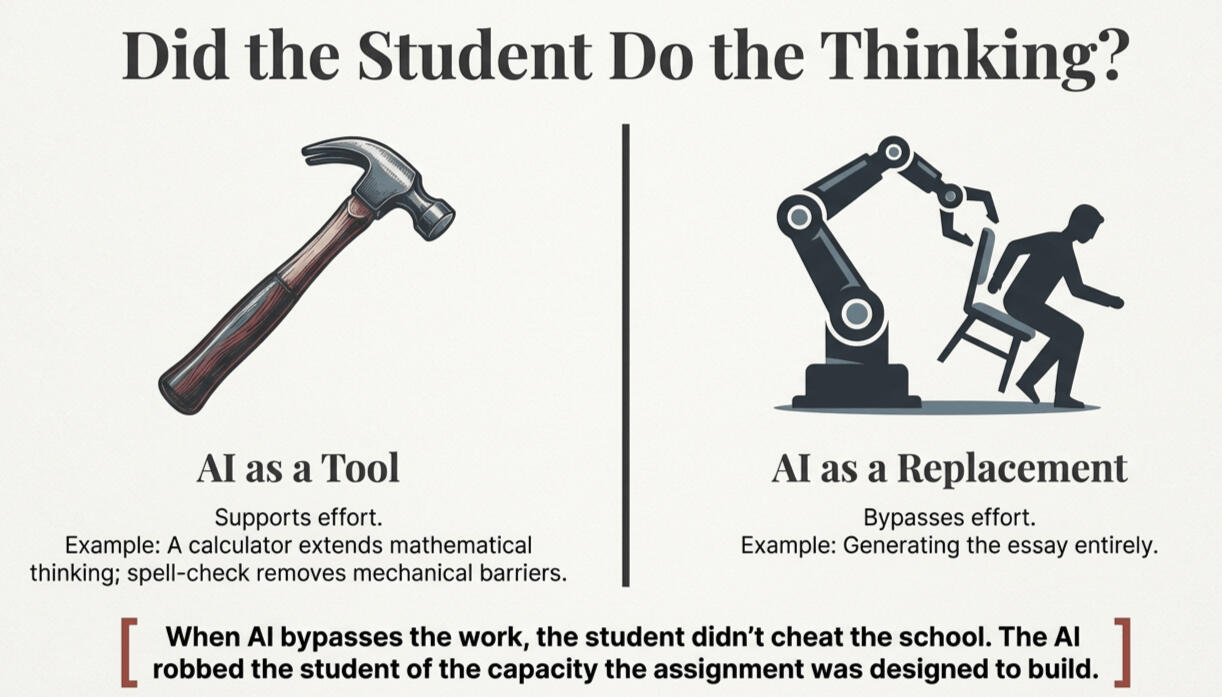
Chapter 3
"Do you Want to Play a Game?"
The AI Question
Chapter GuideEvery problem in this book follows the same path. Identify it. Frame it so others can see it. Build a plan with clear first steps. Execute, iterate, and keep moving forward.The AI problem is easy to identify. Every teacher already sees it. A student turns in an essay that reads better than anything they have ever written in class. A homework assignment comes back polished, organized, and completely detached from the student’s actual understanding of the material. A research paper arrives with clean paragraphs and confident analysis from a student who cannot explain a single point in it when asked.
- 69 -
Teachers see this every week. Parents suspect it. Administrators hear about it. The problem is not hidden.But framing it is harder than it looks. AI is not a phone. You cannot put it in a pouch and lock it away. It is not a single device or a single platform. It is everywhere. It is built into search engines, writing tools, homework apps, and the devices schools themselves provide. And unlike phones, where the argument is straightforward and the evidence is overwhelming, AI arrives wrapped in the language of progress. Innovation. The future of learning. Twenty-first century skills.That language makes it harder to frame the problem clearly. Because the problem is not AI itself. The problem is what happens when AI replaces the work that builds a student’s capacity. And framing that distinction, clearly enough that teachers, parents, and administrators can act on it, is the challenge this chapter takes on.The GameIn 1983, a movie called WarGames asked a simple question. A military supercomputer, designed to simulate nuclear war, is accidentally activated by a teenager who thinks he is playing a game. The computer begins running scenarios. Attack. Counterattack. Escalation. The system cycles through every possible strategy, faster and faster, searching for the move that wins.It never finds one.The computer’s final conclusion, after running every simulation it can generate, is a single line that became one of the most quoted in movie history: The only winning move is not to play.That line has stayed with me for forty years. Not because of the nuclear war plot, but because of what it says about games that look winnable but are not.AI in schools is that kind of game.
- 70 -
It offers students what looks like a shortcut. Type a prompt, get an essay. Ask a question, get the answer. Submit the assignment, get the grade. From the student’s perspective, the game just got easier. The move looks like winning.But it is not winning. It is the opposite. The student got the output without doing the work that the output was supposed to produce. The grade shows up. The learning does not. And the longer the student plays that game, the wider the gap grows between what the transcript says they know and what they actually know.That gap is the problem. And it is growing faster than most schools realize.The InterviewA university professor I know recently shared something that stopped me cold.
She teaches 300 and 400 level courses. The upper divisions. The students in the room have already passed prerequisite courses. They attend class. They participate in quizzes. She gave them the exam questions in advance so they could prepare. By every measure, these students had every advantage going into the midterm.The class average was 64 out of 100.In a normal year, this course averages between 80 and 85. These are not first-semester freshmen who wandered into the wrong room. These are students who chose this field, who have been in the program for years, who show up and do the visible work.When she dug into what happened, the pattern became clear. Students had been using AI to summarize the readings instead of reading them. They used AI to generate study notes instead of building their own. They used AI to draft responses to practice questions instead of working through the material.And they thought it worked. That is the part that matters most. They did not feel unprepared. They felt confident. They believed they understood the concepts. When the exam asked them to define a term, connect an argument, or apply a framework to a new problem, they could not do it. Not because they were lazy. Not because they did not care.
- 71 -
But because they had never actually done the cognitive work. They had watched AI do it for them and mistaken watching for learning.Her experience is not unique. Dr. Sally Sharif, a political science professor at the University of British Columbia, posted similar findings on social media in early 2026. Students in her courses showed the same pattern: high confidence going into exams, poor performance when asked to demonstrate actual understanding. The students themselves reported that they thought they knew the material. They could not explain why they did not.The answer, in both cases, is the same. The students processed information through AI instead of processing it through their own thinking. The output looked like learning. But the neural work that turns information into understanding never happened.The TightropeThe professor’s situation gets more complicated when it moves from the classroom to the conference room.She is building a case for tenure. The administrator sitting across from her in the review is someone who has fully embraced AI as the future of higher education. This administrator talks about innovation, about meeting students where they are, about leveraging technology to enhance learning outcomes. The administrator has never sat in the back of a classroom watching a student submit a beautifully structured essay and then fail to explain the first paragraph of it.So the professor has to thread a needle. She has to be honest about what she is seeing, where students who rely on AI to process the material are arriving at exams with confidence and leaving with failing grades, without sounding like she is against innovation. She has to frame the damage without sounding like she is blaming the technology. She has to tell the truth to someone who does not want to hear it, while her career hangs in the balance.
- 72 -
She frames it carefully. She talks about being excited about AI’s role in fostering creativity and accessibility. She acknowledges the real benefits. She uses the language the administrator wants to hear. And then she lands on the point that matters: we need guardrails to ensure AI does not shortcut the mental wrestling that makes knowledge stick.That is a good line. It is the right line. But the fact that a professor has to perform that kind of rhetorical gymnastics just to say what every teacher in the building already knows tells you something about the institutional pressure around AI right now.The pressure runs toward adoption. It runs toward enthusiasm. It runs toward appearing forward-thinking. And it runs directly away from the hardest question in education today.Did the student do the thinking?That is the position we are putting teachers in. Not just at the university level. In high schools across the country, the same dynamic plays out every day. A teacher watches AI erode the quality of student thinking. The teacher raises a concern. And the institutional response is some version of: We need to embrace AI, not resist it.That response is not wrong. But it is incomplete. It skips the question that determines whether AI helps students or hollows them out.Tool or ReplacementI said in the introduction that technology changed my life, and I meant it. Spell-check in a WordStar program in 1984 did not make me a better writer by writing for me. It removed a mechanical barrier so I could focus on my ideas. That is what a tool does. It handles what the machine does better so the human can do what only the human can do.A calculator does not replace mathematical thinking. It extends it. The student still has to know what operation to perform, why that operation matters, and what the result means. The calculator handles the arithmetic. The student handles the reasoning.
- 73 -
That is the line. And it is not a blurry line. It is clean.AI that helps a student organize thoughts they have already developed is a tool. AI that generates the thoughts is a replacement. AI that checks grammar after a student has written a draft is a tool. AI that writes the draft is a replacement. AI that suggests research directions after a student has formed a question is a tool. AI that produces the research paper is a replacement.The distinction comes down to one question: Did the student do the thinking?If the answer is yes, AI may have assisted the process. If the answer is no, AI replaced the student. The assignment is complete. The grade is recorded. But nothing was learned.And here is the part most people frame wrong. When a student uses AI to bypass the cognitive work, the common reaction is to say the student cheated the teacher. Or cheated the school. But that is not what happened. The AI robbed the student. It took the one thing the assignment was designed to build: the student’s own capacity. The teacher still gets paid. The school still operates. The student is the one who lost something. And in most cases, the student does not even realize it yet.The Science of StruggleThere is a name for what is happening, and it comes from research that has been around for decades.Cognitive Load Theory, developed by educational psychologist John Sweller, explains how the brain processes new information. The theory identifies three types of mental effort involved in learning.The first is intrinsic load. This is the difficulty that comes from the material itself. Some things are just hard. Learning to write a clear argument is harder than filling in a worksheet. Analyzing a primary source is harder than reading a summary. Intrinsic load scales with complexity, and there is no shortcut around it if you want real understanding.
- 74 -
The second is extraneous load. This is unnecessary friction that gets in the way of learning. A confusing assignment sheet. A cluttered classroom. A poorly designed textbook. This kind of load does not build anything. It just wastes mental energy. Good teaching reduces extraneous load so students can focus on what matters.The third is germane load. This is the productive struggle. The mental effort of connecting new information to what you already know. Building frameworks. Revising your understanding when something does not fit. This is the load that actually builds learning. It is the cognitive equivalent of cracking the eggs and stirring the batter. It is the work that creates ownership.Here is the problem. AI is excellent at reducing the first two types of load. It can simplify complex material. It can remove unnecessary friction. And those are genuinely helpful functions. Nobody is arguing against making learning more accessible or removing barriers that do not serve a purpose.But AI does not stop there. It also eliminates germane load. It removes the productive struggle. It takes over the mental work that was supposed to build the student’s capacity. And when that happens, the student gets the output without the development. The grade without the growth. The diploma without the understanding.This is not a theoretical concern. Recent research is making it measurable.A 2025 study from the MIT Media Lab used brain imaging to measure neural engagement during essay writing. Students who used ChatGPT to generate their work showed the lowest levels of brain activity. Reduced neural engagement. Reduced linguistic processing. Many eventually stopped interacting with the material at all and simply copied what the AI produced. The brain scans showed what teachers have been saying for two years: the students were not doing the thinking.A 2026 report from the Brookings Institution found that AI use in education undermines cognitive development, critical thinking, and creativity. Not in theory. In observed outcomes. Students who relied heavily on AI tools showed measurable declines in the kinds of thinking that education is supposed to build.
- 75 -
And perhaps most telling, a 2025 survey reported by The Guardian found that 62 percent of students said AI had negatively impacted their own skills. Twenty-five percent said it had limited their creativity. The students are not unaware of what is happening. They can feel the difference between doing the work and having the work done for them. They just do not always have the language to describe it, or the structural support to choose differently.This is not an argument against making things easier. It is an argument for protecting the difficulty that matters. Reducing extraneous load is good teaching. Eliminating germane load is the opposite. And right now, AI is doing both at the same time, and most schools have no policy that distinguishes between the two.The Eggs AgainThis is the cake mix problem from Chapter 1, showing up in a different form.When Betty Crocker made cake mix that only required water, nobody valued it. Customers rejected it. Not because the cake tasted bad, but because the process felt hollow. When the company added eggs and butter back into the recipe, sales took off. The effort created ownership. The ownership created value. People were proud of something they had invested in, even though the investment cost something.AI is removing the eggs from education.When a student works through a draft, struggles with an argument, revises and rethinks and tries again, the final product carries weight. It belongs to them. They built it. They can stand behind it, explain it, defend it, apply it. That is the educational version of cracking the eggs and stirring the batter.When AI does that work, the product still exists. The essay still gets printed. The assignment still gets submitted. But the student has no ownership of it. They cannot explain it. They cannot defend it. They cannot build on it. They received a finished product without doing the work that makes the product meaningful.
- 76 -
And just like the cake mix, the result looks the same on the outside. A teacher holds two essays. One was built through three drafts, two rounds of revision, and genuine cognitive struggle. The other was generated by AI in thirty seconds. Both look polished. Both meet the rubric. But only one of them changed the student who wrote it.That difference matters. And it is the difference schools need to protect.The Yearbook ProblemI produce the school yearbook. Every year, I take photographs that students and staff have already seen, moments they already lived through, and organize them into a book.Here is what I have learned from doing this work. Repackaged memory has limited value. When the yearbook simply collects photos that everyone has already scrolled past on social media, it feels like a product nobody asked for. A compilation of things people already consumed. The book exists, but nobody values it the way yearbooks used to be valued.What makes a yearbook worth something is original creation under constraint. A photo that captures a moment nobody else saw. A layout that tells a story that did not exist until someone built it. A caption that reframes an experience in a way the reader had not considered. That is the work. That is what makes the product more than the sum of its already-seen parts.AI-generated student work has the same problem. It is repackaged content. The AI pulls from what already exists, reorganizes it, polishes it, and hands it back. The output looks complete. But it was never original. Nobody struggled to create it. Nobody made a creative choice under pressure. Nobody had to decide what mattered and what did not.When learning becomes repackaged output, when assignments become compilations of content the AI already had, the educational product loses the same thing the yearbook loses. It loses the evidence that someone was there. That someone did the work. That the process of building it changed the person who built it.Original creation under constraint is hard. That is not a flaw. That is the point.
- 77 -
What Gets Lost, and What They Will NeedThe damage from unchecked AI use is not always visible on a transcript. It shows up later.It shows up when a student arrives at a university course, like the professors I described, and cannot perform on a closed-book exam because they never built the mental architecture the earlier courses were supposed to develop. It shows up when a young adult enters a workplace and cannot solve a novel problem because every problem they encountered in school was solved by a machine. It shows up when a generation of graduates holds diplomas that certify completion but not capacity.And this matters more in high school than it does in college, because the adolescent brain is still under construction. The prefrontal cortex, the part of the brain responsible for complex reasoning, planning, and judgment, does not finish developing until the mid-twenties. Every cognitive challenge a teenager faces is not just an assignment. It is brain-building. When AI removes that challenge, it does not just skip the homework. It skips the development.Teachers see the effects already. The student who submits polished work but cannot answer a follow-up question. The class discussion that goes nowhere because nobody has actually processed the reading. The growing gap between what students produce on a screen and what they can demonstrate in person.This is what demoralized teachers look like. Not tired from the workload. Tired from watching the work stop mattering.But here is the part of this conversation that most schools are not having yet. And it may be the most important part.The world these students are walking into will run on AI. That is not speculation. It is already happening. The pace of change in artificial intelligence over the past two years has been unlike anything most people have seen in their careers. Tasks that required teams of professionals a year ago are being completed by AI in hours. Industries that felt untouchable are watching their workflows transform. The students sitting in our
- 78 -
classrooms right now will graduate into a world where AI is not a novelty. It is the infrastructure.And that fact does not weaken the argument for protecting struggle. It makes it stronger.Because here is what AI cannot do. It cannot judge whether its own output is true. It cannot decide whether a solution is right for the situation or just right on paper. It cannot weigh competing values. It cannot read a room. It cannot lead a team through a decision that has no clean answer. It cannot look a person in the eye and say, I understand what you are going through.Those are human capacities. They are built through years of practice, failure, revision, and real interaction with other people. They are built in classrooms where students do the thinking. They are built through exactly the kind of productive struggle that AI, used as a replacement, eliminates.The students who will thrive in an AI-driven world are not the ones who learned to let AI do the work. They are the ones who built the capacity to think, decide, and create so that when they sit down next to AI, they have something to bring to the table. AI needs a human who can think. That is what school is supposed to build.If we let AI replace the struggle now, we are not preparing students for the future. We are hollowing them out before they get there.Where the Line FallsSchools need clear, specific, enforceable policies on AI use. Not blanket bans, which are unenforceable and send the wrong message. Not open adoption, which surrenders academic integrity. What they need are policies that draw the line at the point of cognitive effort.The principle is simple: Did the student do the thinking?
- 79 -
Here is what that looks like in practice.Using AI to brainstorm topics after the student has already identified a general interest? That is a tool. The student did the initial thinking. AI helped expand the options.Using AI to generate the thesis statement? That crosses the line. The thesis is the argument. If the student did not build it, the student did not do the thinking.Using AI to check grammar and spelling after the student has written a complete draft? That is a tool. This is spell-check with better technology. The student did the writing. AI cleaned up the mechanics.Using AI to write the first draft? That crosses the line. The first draft is where thinking happens. It is where the student discovers what they actually know and what they do not. Skipping that process skips the learning.Using AI to explain a concept the student is struggling with, like a tutor? That is a tool. The student is doing the learning. AI is assisting the process.Using AI to produce the final answer to a problem set? That crosses the line. The answer without the process is a number without understanding.In the language of Cognitive Load Theory, the first example in each pair reduces extraneous load. It removes friction without removing effort. The second example eliminates germane load. It removes the productive struggle that builds understanding. That is the distinction schools need to make, and it is not a difficult one to explain. A teacher can communicate it in five minutes. A parent can understand it in two.The question is whether the school is willing to make the distinction official, put it in writing, and enforce it.Enforcement does not require perfect detection. It requires a culture where the expectation is clear. Students should know, before they open the AI tool, exactly where the line is. Teachers should have institutional backing when they hold that line. Parents should understand what the school expects and why.The schools that will get this right are the ones that treat AI policy the way they should treat every structural decision. They will name the standard. They will communicate it
- 80 -
clearly. They will enforce it consistently. And they will not lower the bar when enforcement gets hard.The Three PillarsThe framework from A Place Where Leaders Are Built applies here the same way it applies to every structural challenge in this book.Responsibility. Students are responsible for their own thinking. Not for producing output. For doing the cognitive work that builds their capacity. When a school makes this expectation clear, it is not punishing students for using technology. It is requiring them to own the most important part of their education. The thinking is theirs. It cannot be outsourced.Real rewards and consequences. Grades must reflect genuine effort and understanding. When a student meets a high standard through their own work, that achievement is recognized and valued. When a student submits AI-generated work and cannot demonstrate understanding, the consequence is real. Not punitive for punishment’s sake, but honest. The grade reflects what the student actually knows. A diploma backed by AI-generated transcripts is a diluted diploma. It devalues every student who did the work the real way.Adults who neither rescue nor abandon. Leaders set AI policies. Teachers enforce them. And when enforcement gets difficult, which it will, the institution does not lower the bar. It also does not give up on students who struggle to meet it. This is the hardest pillar to hold. It is easier to ignore the problem. It is easier to pretend that AI use is not happening, or that it does not matter, or that the students will figure it out eventually. But none of those responses are leadership. Leadership is holding the standard and staying in the room.
- 81 -
What Comes NextAI is not going away. This chapter does not argue that it should. Technology shifts create fear. They always have. I know this from my own career. The question has never been whether a new technology will arrive. The question is whether we integrate it without surrendering what matters.In schools, what matters is struggle. The cognitive effort of working through a problem, constructing an argument, revising a draft, failing and trying again. That is not an obstacle to learning. It is learning. When AI performs that work for the student, it does not assist education. It bypasses it.The research is clear. The MIT Media Lab has shown that AI use reduces neural engagement during the exact tasks education is designed to develop. Brookings has documented the erosion of critical thinking and creativity. And the students themselves are telling us they can feel the difference. Sixty-two percent of them say so.But this chapter is not just a warning. It is also a responsibility.The world is changing fast. AI is not a trend that will pass. It is a transformation of how work gets done, how problems get solved, and how value gets created. The students in our classrooms right now will live their entire adult lives in that world. Every industry they enter, every career they build, every challenge they face will involve AI in some form. That is the reality, and there is no version of responsible education that ignores it.Which means schools have two jobs, not one. The first job is to protect the struggle that builds capacity. The second job is to make sure students graduate knowing how to work alongside AI, not underneath it. Those two jobs are not in conflict. They are the same job. Because the student who has built real capacity, who can think critically, reason through a problem, and make a judgment call when the data is incomplete, is the student who will use AI as a force multiplier. The student who skipped the struggle and let AI do the thinking has nothing to multiply.AI needs a human who can think. That is what school builds. Or at least, that is what school is supposed to build.
- 82 -
The schools that get ahead of this will be the ones that stop treating AI as either a miracle or a threat and start treating it as what it is: a powerful tool that requires clear structural boundaries. The same way a school-wide phone ban during school hours protects attention, a clear AI policy protects thinking. Both are structural decisions. Both require institutional will. Both will face pushback. And both are necessary.School boards can start by putting the question on the agenda. Not as a technology discussion. As a standards discussion. What are we willing to accept as evidence that a student has learned? Does a grade reflect understanding or output? Does a diploma certify capacity or completion?Teachers can start by having the conversation with their students. Not a lecture. A conversation. Most students, when asked honestly, already know the difference between using AI as a tool and using it as a replacement. They know when they are doing the thinking and when they are not. The conversation is not about catching them. It is about helping them understand what they lose when they stop doing the work, and what they gain when they keep doing it.Parents can start by asking one question at the dinner table: Did you do the thinking today, or did something else do it for you?That question, asked consistently, is worth more than any detection software.The AI question is not a technology question. It is the same question this entire book has been asking since the first page. Are we willing to require the effort that makes education real? Are we willing to build the capacity our students will actually need? Or are we going to let the simulation win because the simulation is easier?The game looks winnable. The shortcut looks smart. But the only winning move is to do the work.End Chapter: Chapter 3 - Administrative Duty and Safety Note
School leaders have a duty to protect authentic learning and ensure that students are still doing the cognitive work school exists to develop. When AI use is left unmanaged, students may appear productive while losing the practice of thinking, and teachers are left in unclear, unstable, and professionally unsupported conditions.
- 83 -
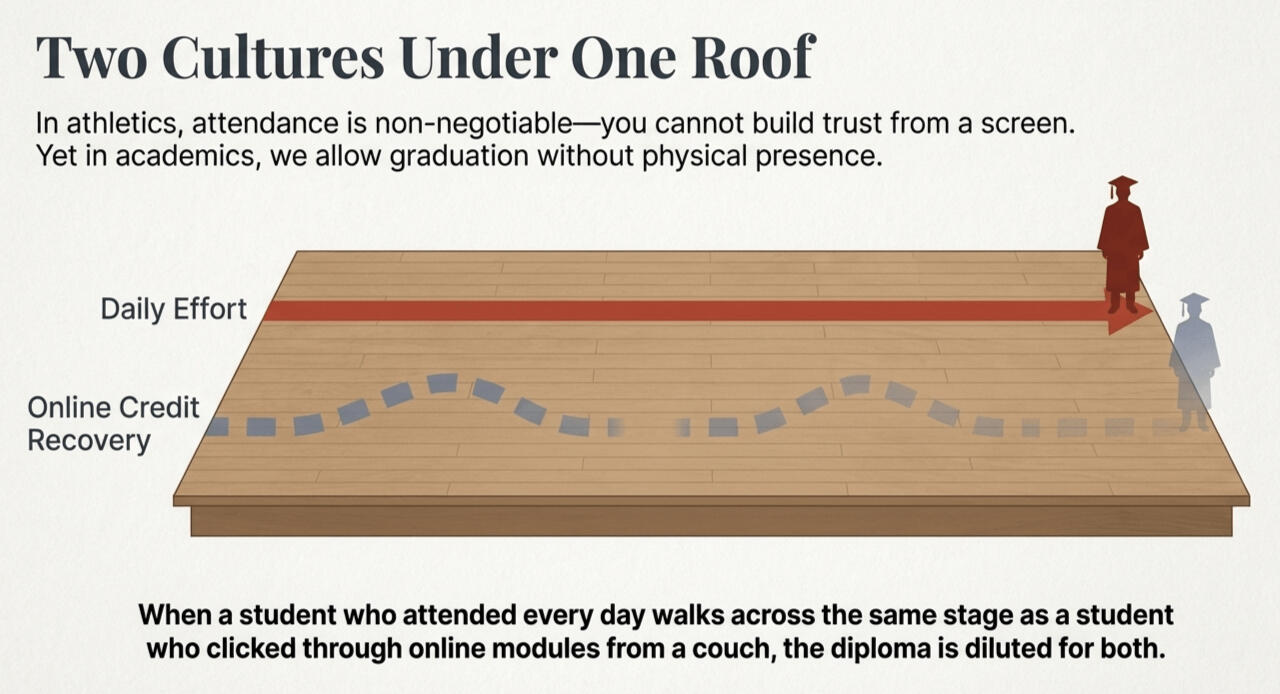
Chapter 4
"If You Build It, They Will Come"
Attendance Is Structural
Chapter GuideThis is the same framework that has opened every chapter in this book. It is a discipline. You identify the real problem, not the symptom. You frame it so others can see it clearly. You build a plan. And you execute, knowing you will iterate along the way.The problem in this chapter is not that students are absent. Students have always been absent. The problem is that schools have built systems that make absence costless. Credit recovery, online modules, and last-minute make-ups, have created a structure in which a student can miss enormous amounts of school and still receive a diploma that is indistinguishable from the one earned by a student who was present every day.That is not an attendance problem. That is a structural honesty problem. And it sends a message to every person in the building: being here is not required. It is optional.
- 84 -
Every Year in MayEvery May, I put on that gown. I drape the hood with the colors that say I earned an MBA. I sit on a folding chair in front of my small mountain community, and I wait for the moment I dread most in the entire school year.It comes when an administrator walks to the podium and says the words I have heard every year for more than a decade: We are proud to announce a one hundred percent graduation rate.The crowd claps. Parents smile. Board members nod. And I sit there, wearing the credentials of a man who has run businesses, coached football, and spent more than twenty years in one of the most heavily regulated industries in America, and I feel sick.Not because the words are untrue. Technically, every student did receive a diploma. But I know what that number cost our community. I know which students attended class almost every day, did the reading, turned in their own work, showed up on time, and earned the grade on the report card. And I know which students missed weeks of school, drifted in and out of the building, failed multiple classes, and were quietly handed online recovery modules in the final month so they could click through enough boxes to walk across the same stage.Same gown. Same handshake. Same diploma.I am not talking about a student who struggled and fought through real difficulty. I am talking about a system that has made a quiet institutional decision: no one fails. The diploma does not mean every student met the standard, but means the institution found a way around the standard for anyone who figured out the system.Every teacher on that stage knows it. Every student who showed up every day knows it. Every parent who made sure their kid got to school on time, every morning, all year, knows it.One hundred percent graduation rate. It sounds like success. It is the opposite. It is the sound of a standard being hollowed out in front of the entire community, and everyone pretending not to notice.
- 85 -
That moment on the stage is the worst day of my school year. I am a positive person. Anyone who knows me will tell you that. I wake up ready to go. I believe in these kids. I believe in this work. But I cannot sit in that chair, year after year, and pretend that graduation number means what it is supposed to mean.This chapter is about attendance. But it is really about what a school communicates when it stops requiring physical presence as a condition of earning a diploma. It is about what happens to the students who do show up when the institution rewards students who do not. And it is about a problem that is more dangerous than most people realize, not just educationally, but physically.Hell or High WaterI should tell you where I come from on attendance, because it matters for understanding why this chapter exists.I had perfect attendance from elementary school through high school graduation. Every year. Not one absence. I received a special award for it when I graduated. And before you think that came easy to a kid who loved school, let me be clear: I had a third-grade reading level when I entered eighth grade. I was dyslexic. School was not the place I went because I was good at it. School was the place I went because my friends were there, my teachers were there, and my coaches were there. There was no other place I wanted to be. I could not escape my reality by reading books or disappearing into some fantasy. My reality was the building. The people in it were my world.One year, a hurricane hit southeast Texas and the floodwaters rose through our neighborhood. My parents could not get out to drive me to school. The roads near our house were underwater. So I called my uncle, and he agreed to meet me where the road was still passable, about a quarter mile away.I waded through waist-deep flood water to get there. A quarter mile through the bayou country of southeast Texas. If you know that landscape, you know what lives in that water. Alligators. Water moccasins. Things you do not want to meet at waist level on a Tuesday morning. I was a kid, and I did it anyway, because I was not going to miss school.
- 86 -
I tell that story not because I think every student should wade through snake-infested water to get to class. I tell it because it reveals something about what I believe, down to the bone, about being present. Attendance was never a box I checked. It was how I stayed connected to the only world that made sense to me. It was how I survived a disability that should have sidelined me. It was the foundation under everything else I eventually built.That belief did not stay in childhood. It followed me into coaching.I coached three years as a middle school assistant when I first arrived at the school, and then twelve seasons as the varsity head coach. I don’t miss practices. I don’t miss weightlifting sessions. I have never missed a game. I am there when the kids arrive in the morning. I’m there when they leave. Everyone in the building knows they can count on me being there. I have accumulated more paid leave than I will ever use, because I just do not take time off. As a Teacher I get plenty of time off during the year, I don’t waste those days with my students and players. Being reliable, being present is something I model for my kids in the building. If I am going to ask these kids to show up, I have to show up first.There is one story I need to tell, and I will tell it simply because the facts are enough.During one of our games on a Saturday afternoon in September, I was called off the field in the 3rd quarter. Something was seriously wrong with my dad. I was told he was in the atrium and I needed to hurry. My dad had been to nearly every game I ever played or coached. He was that kind of father. When I got to him, he had suffered a heart attack. They were trying to resuscitate him, but he never recovered. He was already gone.I missed a quarter and a half of that game to hold my dad's hand.I took off the following Monday to be with my mom and make the funeral arrangements. We spent most of the day working through what needed to be done. But at 4 PM I was back at the school. It was the place I wanted to be. Practice starts at 4 PM. You show up for your team. Being present is important for young men to see and rely on.I’m not normal in this way. I know it. And I know it might seem like I put too much weight on being there. But I believe that what you model matters more than what you say. If I want these kids to understand that showing up is the foundation of everything, then I have to live it. Not just on the easy days. On even the worst days of your life.
- 87 -
To be successful, they are going to have to show up. And I believe that starts at school.So yes. I come to this chapter from a place that maybe overvalues attendance. I own that. But you should value the ideas on the importance of attendance policies from someone who waded through floodwater as a kid and showed up for practice after a tragedy rather than on the side of an institution that cannot be bothered to enforce a closed campus policy.The Closed Campus That Isn'tMy school has a closed campus. That is what the handbook says. Only seniors are allowed to sign themselves out during the school day. That is the policy.Here is the reality.A freshman, sophomore, or junior decides they do not want to be in fifth period. Maybe there is a test. Maybe the coffee shop down the road sounds better than a class. So they text their parents. The message is simple: I have nothing going on. (Not true) Can you call the office so I can leave campus?The parent calls. The student walks out. They get in a car with another student. Sometimes the weather is terrible. There is no verification. No check on where they are going. No confirmation that the driver has a license or insurance. No adult in the building follows up. The SRO does not say a word. The principal does not say a word. The superintendent does not say a word.A student can skip a class, be marked absent, and no one goes looking for them.And the absence does not just affect the student who left. It radiates. The other students in the class saw them go. They know the student texted a parent, got a call placed to the office, and walked out. They know the student is at the coffee shop or at home or in someone else's car. And they know that nothing happened. No consequence. No follow-up. No conversation.The skip is not quite. It is visible, and everyone in the building absorbs the lesson: you can leave, and nobody will stop you.
- 88 -
For the teacher, this is demoralizing. They are standing at the front of a room trying to create something meaningful, and a student just does not show up. They where there, in the building, and now they are gone. All with institutional permission. The teacher cannot override the parent's phone call. The office approves with a simple signout sheet. The teacher is stuck. They can only watch it happen everyday and continue teaching the students who remain, knowing that the student who left may have done so to avoid the very assessment the remaining students are about to take. And when that student returns the next day, the teacher will be expected to provide a separate test, to reteach what was missed, and to treat the absence as though it were a neutral event.You don’t want to take a test in the fifth period? There is a way out. Leave school. The teacher has to make it up to you later. The incentive structure could not be clearer.But there is another dimension to this that moves beyond education and into something more dangerous, and I want to say it directly in this next section.The Lawsuit Nobody Sees ComingI want to paint a picture that no one in the building wants to think about. But someone has to, because the risk is real and it is growing every day the sign-out policy goes unenforced.A student signs out during the school day. Maybe a parent called. Maybe they didn't. Maybe the sheet in the secondary office window has a name on it, maybe it has a scribble, maybe the call log does not match the sign-out sheet at all. There are students who sign themselves out without an associated parent call, and nobody catches it because nobody audits the paperwork. The system runs on trust, and that trust is misplaced. Any auditor could look at the logs and find the pattern in an afternoon. The way the system runs now, a middle school or high school student can walk up to the secondary office, tell the person at the desk (when there is a person at that desk) that their parent is waiting at the front entrance downstairs, they have a dentist appointment, sign the sheet, and walk out of the building without a single adult verifying the claim.That student gets in a car with a student or even an adult from outside the building. It is the middle of a school day. They are on a mountain road in Colorado, where the weather turns fast and the margins are thin. And something terrible happens. An accident. A serious injury. A death.
- 89 -
The grief would rip through our community. In a school of a hundred students, everyone knows everyone. There is no distance from a tragedy like that. Every teacher, every coach, every student, every family would feel it.But the grief would not be the end of it. I know this because I spent more than twenty years in the casino industry as an owner operator, which is one of the most heavily sued industries in the country. A fall. A trip on an escalator. A slip on a wet floor. Every incident, no matter how minor, attracted attorneys. I lived it. I managed it. I learned how liability works not from a textbook but from depositions, demand letters, and settlement negotiations.Schools and government entities face the same exposure. And here is what would happen next.The tragedy would be reported in the papers. Within days, the parents of that injured or deceased student would be contacted by attorneys. That is not speculation. That is how the system works. A grieving parent, devastated and looking for answers, would be told that the school may be liable. That the institution had a duty of care. That the student left the building during school hours. That the sign-out procedures were inadequate. That the school cannot produce a clean audit trail showing a verified parent call, a confirmed destination, a documented release.And the attorney would be right.A school that cannot produce paperwork showing that every student who left the building was properly called out by a parent, verified by staff, and logged in an auditable system has no defense. Even a quick trip out the doors to grab something from a car in the parking lot needs oversight. The closed campus policy in the handbook becomes evidence against the school, because it proves the institution knew students were not supposed to leave without authorization and failed to enforce its own rule.In any regulated industry, the insurance carrier and the legal counsel exist to identify this kind of risk before it becomes a claim. That is their job. A casino's insurance company does not wait for someone to get hurt. They audit. They inspect. They require documentation. They demand that the operation can prove, on paper, that every reasonable precaution was taken. If the operation cannot prove it, the carrier raises the rates or drops the coverage.I do not understand how a school's insurance provider or legal counsel can look at a sign-out system that cannot be audited, a closed campus policy that is not enforced, and minors leaving the building during school hours without verified documentation, and not flag it as an unacceptable liability. My guess is that they don’t know it is happening or don’t have an adequate inspection/auditing department. In the casino industry, that
- 90 -
kind of willful blindness would cost you your license. In a school, it will cost the district millions when this type of tragedy strikes. The trust system may work most of the time, but it’s just a matter of time before this structural attendance oversight causes real heartbreak.The tragedy would be the loss of one of our loved students. The financial devastation that follows would be the institution's. And both were preventable. Let me say it again. Losing track of students and the financial risks vector are both completely preventable.Nobody in the school’s building is talking about this. They should be.If this book does nothing else but expose this structural attendance policy weakness, I feel that it has done something. I have never had high hopes that every piece of this framework would be implemented in every school that reads it. Structural change is hard. People resist it. But when insurance companies and attorneys get involved, things change in my experience. Something I learned in twenty years of running a casino business. The principal, superintendent and school board may ignore a coach with his cute little book. They will not ignore a carrier threatening to pull the school’s coverage.I know that teachers are tired. I know that many of them have been beaten down by years of asking for structural changes that never come. Some have stopped asking. They feel powerless to make any real change, and honestly, most of the time, they are right. The system does not listen to teachers.But this one section is different. This is not a request for better classroom engagement strategies. This is not a suggestion for a new professional development workshop. This is a liability exposure that could cost a district millions of dollars and end careers. Any school board member or administrator who reads this section and does not immediately develop and implement strong and auditable sign-out procedures, upgrade its closed campus enforcement, and the documentation trail is choosing to accept a risk they cannot afford. The information has now been served. No one can unknow this after reading this section. If the administration continues to use the delay and inaction strategy it currently uses for structural change policy requests, the over exposure and risk to our community caused by continued inaction will now only have one place to point.After reading this chapter and section, you might think that Coach Ball is just railing about attendance because it came easy to him. The guy who waded through floodwater. The guy who never missed a practice. The guy who was back at 4 PM the day his father died. Of course he thinks everyone should show up. It is easy to demand something you never struggled with.
- 91 -
But this chapter is not just about absenteeism. It is not just about grades and credits and graduation rates. It is about something more fundamental than any of that.When a parent drops their child off at a school in the morning, they are placing that child in our care. That is not a metaphor. It is a legal and moral obligation. For the hours between that drop-off and that pick-up, we are responsible for where that child is, who they are with, and whether they are safe.An attendance policy is not just an academic tool. It is how we account for the children entrusted to us. It is how we know where they are. It is how we keep them in the building, in the classroom, under the supervision of adults who are trained and obligated to protect them. Every time a student walks out of that building without proper documentation, without verification, without anyone checking where they are going or who they are going with, we have failed that responsibility.Being present is not just how students learn. It is how we keep them safe. And keeping them safe is not a policy debate. It is the promise we made when we opened the doors.This is the one issue I can point to above all others as an example of how change is hard to push in a public school. I’ve pointed out this risk to every administrator I have ever been linked to over the years and nothing has ever changed. Maybe putting it in the pages of this book for all to see will do the trick. I have always been the one at my school that is uniquely qualified to solve this problem. I’ve offered my help but it is easier to do nothing than to fix a problem. This one section is a testament to the phenomenon of change is hard.Still in the RoomIn Chapter 2, I described the Snapchat scores I discovered when I had students open their accounts during a classroom exercise. My score, accumulated over years of casual use, was around fifty thousand. Ten students in my classroom had scores over seven hundred fifty thousand. Some topped one and two million. The numbers told a story about how deeply embedded the phone is in the social architecture of a teenager's life.But here is the part of that story I saved for this chapter.The absent students are not gone. They are just not in the building.A student who stays home from school, or is skipping class, is still in every Snapchat group. Every intra day drama. Badgering students in school to ditch. They are still texting with the kids who are sitting in class. They are still seeing the snaps from the
- 92 -
bathroom, the hallway, the cafeteria. They are still involved in every social conflict, every rumor, every fight. They are still talking about teachers behind their backs, in real time, with students who are physically in the classroom being derogatory about the person standing at the front of the room.They are watching someone vape in the bathroom through a snap. They are commenting on a conflict in the hallway they were never physically near. They are present in every group chat, every inside joke, every piece of social currency that circulates through the building. The only thing missing is their body.The phone did not just steal attention from the room, which was the argument in Chapter 2. The phone erased the social cost of not being in the building. A student who misses school does not feel like they missed anything, because digitally, they were there the entire time.This is the intersection of the phone problem and the attendance problem. When social life is fully digital, physical presence in the building becomes optional. They get the benefits of social attachment without the cost of coming to school. The student does not need to be in the room to be in the conversation. They do not need to attend class to stay connected. The phone bridges the gap so completely that the student's body becomes the only thing missing from the school day.And if the body is the only thing missing, and the school does not require the body to be there in order to earn the credential, then what exactly is the school building for?What the Numbers SayBefore the pandemic, roughly fifteen percent of American students were chronically absent, meaning they missed ten percent or more of the school year, about eighteen days. That number was already a concern. It is now nearly unrecognizable.By the 2021-22 school year, chronic absenteeism had roughly doubled to around thirty-one percent nationally. It has come down slowly since then, to approximately twenty-two to twenty-four percent in 2024-25, depending on the data source. But that decline has stalled. And the definition itself hides the severity of the problem. Ten percent of the school year is the threshold. That is the floor, not the ceiling. A growing
- 93 -
number of students are not missing ten percent. They are missing twenty. Thirty. Some are missing more days than they attend. The chronic absenteeism rate tells you how many students crossed the line. It does not tell you how far past it they went.In Colorado, where I teach, chronic absenteeism is running close to twenty-eight percent statewide. In rural and Western Slope districts, it is above thirty-six percent. In high schools, nearly one in three seniors is chronically absent. These are not outliers. They are the trend.The country went from roughly one in seven students chronically absent before the pandemic to roughly one in four. In many communities, it is closer to one in three. And in small schools like mine, where a hundred students total means that every empty seat is visible and every absence is felt by the teacher and the remaining students, the impact is not statistical. It is personal.The research on what chronic absence does is not ambiguous. Students who miss more than ten percent of school perform significantly worse in reading and math. The effects compound over time. By sixth grade, chronic absenteeism is one of the strongest predictors of whether a student will eventually disengage entirely.But here is what makes the problem circular. When institutions respond to poor attendance not by raising expectations but by building easier pathways to the credential, they remove the last structural reason a student has to be in the building. The student who misses three weeks and is handed a recovery module learns that absence has no cost. The student who is watching that happen from the next desk learns the same lesson. And the next semester, the number of empty seats grows.Attendance only matters if the institution treats it like it matters. When the school will graduate you regardless of whether you showed up, showing up becomes a personal preference rather than a structural expectation. And personal preference, left to compete with a couch and a phone, loses every time.Two Cultures Under One RoofI described this in the introduction, but the attendance chapter is where it lives.
- 94 -
Two cultures are forming inside American schools. In one culture, families believe that showing up matters. They believe that physical presence, daily effort, and participation in the shared life of the school are not optional. The student is there. Every day. Even when it is hard. Even when they do not feel like it. Because showing up is what you do when something matters.In the other culture, families believe that completion is enough. As long as the credits are earned and the boxes are checked, the method does not matter. If the student can finish the work online, why does it matter whether they were sitting in the room? If the diploma is the goal, any path that reaches the diploma is acceptable.Both of these cultures exist in the same building. They walk the same hallways. They share the same teachers. And at the end of the year, they walk across the same stage.The problem is not that the second culture exists. There have always been students and families who did not prioritize school attendance. The problem is that institutions have built systems that serve the second culture at the expense of the first.Credit recovery is the most visible example. A student fails a course, often because they were not present for enough of it to learn the material. Instead of repeating the course with the same expectations, the student is given access to an online recovery module. The module can be completed from anywhere. In many cases, it does not require the student to demonstrate mastery to a human being. It requires clicking through screens, answering enough questions to pass a low threshold, and submitting the completion. In the age of AI, the student may not even be the one doing the clicking.The student passes. The credit is awarded. The graduation rate is preserved.And the student who sat in that classroom every day, who did the reading, who struggled through the material, who asked questions and revised their work, watches the system hand an identical credential to someone who was barely in the room.That is not an attendance policy failure. It is a values statement. The institution has communicated, through its structure, that presence was never actually the standard. Completion was the standard. And completion, it turns out, can be purchased without showing up.
- 95 -
The ExperimentEvery semester, I run a simple experiment in my classroom. It is not scientific. It is not published in a journal. But it reveals the two cultures more clearly than any statistic ever could.I pick a unit we are about to spend significant time on. Usually it is a coding unit. Material the students have never seen before. On the first day of our unit, I give them a pretest, the way many teachers do, to measure what students already know before we begin.Here is where my pretest is different from the standard check for known knowledge. The day before the test, I give the class the full test. Every question. Every answer. I hand it to them. All they have to do is study it. The next day, they take the test without their computers and without the question-and-answer sheet I gave them the day before.If you are reading this and you went to school at any point in your life, you understand what a gift that is. Think about what it would have meant to you if a teacher handed you the actual test with the actual answers the day before. When I was in school, if someone got a copy of a test ahead of time, maybe even ill-gotten, they were suddenly the most popular person in the building. Some Industrious student might even sell copies. You could easily make 100%. You might even miss at least one question on purpose just so your teacher wouldn’t get suspicious.That is not what happens in today’s classroom with the two cultures in one building.A group of students will score 100%. They took the questions and answers home, studied them, and showed up prepared. They invested the effort. They treated the opportunity like it was worth something.Another group will fail. Not because the material was too hard. Not because they did not have what they needed to succeed. They had every question and every answer in their hands. They failed because they did not look at it. They did not study. They did not prepare. The effort of reviewing the material the night before was more than they were willing to invest, even when the payoff was a guaranteed perfect score.That is the two cultures in one room. One culture values effort and investment. The other values completion, and when completion requires even a small amount of effort, they opt out.This is not a failing grade in the traditional sense. The material is brand new. Most students would struggle on this pretest without any preparation because they have never
- 96 -
seen the subject matter before. That is expected. What is not expected is that a student who holds the answers in their hands will choose not to use them.But that is what happens. Every semester. And this experiment can be recreated in any classroom, in any school, with any subject across America right now. Give the students every advantage. Remove every barrier. Hand them the answers. And watch who does the work.That will tell you everything you need to know about which culture is winning in your building.When a teacher does not understand this difference, they are in for a long haul. They will stand in front of a classroom and pour hours into trying to reach a student who will not engage. They will rework lessons. They will offer extra help. They will stay after school. And none of it will work, because the student does not see value in what is being offered and has no intention of investing effort in it. That quiet defiance looks like a student who needs help or that the teacher needs to apply some differentiation strategy. If a teacher does not recognize that the two cultures exist, a teacher can burn through an entire career trying to solve the puzzle before realizing the problem was never in the lesson plan.This is one of the reasons I have lasted as long as I have. I run this experiment early, every semester, because it tells me who I am working with. It tells me which students are ready to invest and which ones I need to reach a different way. I still work to reach the second group. But I stop pretending the problem is my lesson plan. The problem is structural, and knowing that early saves a teacher from burning out trying to solve something that was never theirs to solve alone.Practice at 4 PM on MondayIn any athletic program in the country, this conversation does not happen. You do not get to skip practice and still start on Friday. You do not get to miss the weight room all week and claim you are prepared. You cannot complete a virtual scrimmage. You cannot recover your reps at the end of the season by clicking through a conditioning module.Practice at 4 PM on Monday is the expectation. If you are not there, there is a consequence. Not because the coach is rigid or punitive, but because everyone on the team understands that physical presence is the prerequisite for everything else. You cannot develop as a player without being there. You cannot build trust with your
- 97 -
teammates from a screen. You cannot be coached by someone who is not in the same room with you.Nobody debates this in athletics. No parent calls the athletic director to say their child should still start even though they missed three practices. No administrator overrides the coach to put a kid in the game who was not at the workouts. The structure is understood. The consequence is accepted. The standard holds.Now apply the same logic to the classroom.If a student misses three weeks of English class, should they receive the same grade as a student who was there every day? If a student skips the science lab, should they earn lab credit by completing a worksheet at home? If a student is absent for half the semester, should a recovery module in May carry the same weight as five months of daily participation?In athletics, the answer to every one of those questions is obvious. In the classroom, we pretend the answer is too complicated to solve.It is not overly complicated. The classroom deserves the same structural honesty we already accept on the practice field. Physical presence is the precondition for the relationship between teacher and student, for the shared experience of a class learning together, for the kind of real-time struggle and feedback that builds capacity. None of that happens through a screen. None of it happens through a module. All of it requires showing up.A Standard in SpedI want to be honest about something. The attendance conversation is never as clean as the athletics analogy, and I am not pretending it is.Some students are absent because of real, serious barriers. Mental health challenges are genuine. Anxiety disorders have increased since the pandemic, and the continued use of self-carry cell phone policies. Some students struggle to get through the door. Transportation in rural communities is unreliable. Family instability, poverty, medical
- 98 -
issues, and caregiving responsibilities all play a role. Some students are absent because their lives outside of school are harder than most adults in the building understand.This book is not arguing that those students should be punished. It is not arguing that every absence reflects a moral failure. And it is not arguing that the answer to chronic absenteeism is a stricter truancy policy and harsher consequences.The answer is support and structure. Not support instead of structure.A school that takes attendance seriously does not just enforce a rule. It builds a system that identifies students who are struggling early, connects them with the right support, removes barriers where possible, and holds the standard at the same time. Early intervention. Tiered supports. Mentoring. Family outreach that asks what a family needs rather than just scolding them for what they are not providing. These approaches work, and the evidence behind them is strong. We have to do our best to get them to school.I say this as someone who lives on both sides of this conversation. In 2020, I was asked to be the school’s 504 federal program coordinator. It is not a paid position. Given my own history with learning disabilities, it felt like a natural fit and a place I could make a real difference. I work with families to craft accommodations that allow teachers to teach and students to learn. Real accommodations. The kind that keep a student in the classroom and give them a genuine path to meeting the standard, not a path around it.I know what it looks like when a student needs help. I also know what it looks like when the system uses “help” as a word for lowering the bar. Those are not the same thing, and the students who need real accommodations are the first ones harmed when the institution stops distinguishing between the two.But none of that changes the institutional standard. The standard is: you need to be here. We will help you get here. We will address what is keeping you away. And we will hold the expectation that being here matters, because it does.What I am arguing against is something different. I am arguing against the institutional decision to treat absence as costless. To build systems where a student can miss enormous amounts of school and still receive the credential. To use credit recovery as a substitute for presence. To quietly lower the bar so the graduation rate stays intact.This type of tolerance is just institutional convenience disguised as compassion. And the students who are harmed most by it are often the very students the tolerance claims to
- 99 -
serve. Those students never develop the habits, relationships, and capacities that daily attendance builds.Running on EmptyThere is another contributor to chronic absenteeism that nobody in the building wants to talk about, and it is hiding in plain sight. It is on the breakfast tray.My school does not have vending machines. It does not serve soda or energy drinks. Students get milk and juice. That sounds reasonable until you read the labels.In January of 2023, I started taking pictures of the breakfast item labels served to students and adding up the numbers. On January 9, students were given milk, two cereals, a juice, a package of fruit, and a granola bar. Before the first bell rang, that tray delivered 54 grams of sugar and 103 grams of carbohydrates. The recommended daily allotment for boys is 36 grams of sugar and 130 grams of carbohydrates. For girls, it is 25 grams and 115 grams. Our school gave them their entire day's worth of sugar before 8 AM.That was not the worst day. On February 14, I recorded the highest totals of any day I tracked: 71 grams of sugar and 139 grams of carbohydrates. In a single breakfast. A girl's full daily sugar allotment, nearly three times over, before the first period.The crash happens at 9:30 AM. Every day. You can see it. Students who were awake and functional at first period are sluggish, irritable, and unfocused by second. Teachers see it. Coaches see it. And when those students go home sick for a day, two days, a week, nobody connects it to what the institution put on the tray that morning. There is no way these kids can be successful on a foundation like this. If you remember the parent walk-through from Chapter 2, the one where I asked you to picture yourself walking the hallways before the first bell, this is what you would see. Kids hunched over with a phone in one hand, eyes glued to the screen, while the other hand is shoveling in sugar. That is the starting line for the school day. Everyone sees it and just walks by like they can’t. Distracted and overfueled before a single class begins. I work the door every morning. I see it every day. And it makes you question what we are doing to these kids. That is a hard thing to take day after day. This scene was one of the biggest drivers that called me to start writing this book.The energy drinks students carry in from outside the building make it worse. My school has a policy against them. Like the closed campus policy, no one enforces it. The pattern
- 100 -
is the same one throughout this entire book. The structure exists on paper. The enforcement does not exist in practice.I am not going to go deep on nutrition in this book. That argument deserves its own space, and it will get it. My next book, Running on Empty: The Fuel Problem Schools Refuse to Fix, will address what we are putting on the tray, what it is doing to the people in the building, and what it costs in attendance, energy, focus, and long-term health for both students and teachers.But I raise it here because it belongs in the attendance conversation. When we talk about why students are absent, we talk about mental health, family instability, and transportation. We rarely talk about the fact that the institution itself is feeding them fuel that makes them sick. That is a structural problem. And like every structural problem in this book, it will not fix itself.Recovery Is Not BelongingCredit recovery was designed to be a safety net. For the student who failed a single course due to a specific hardship, recovery offered a path back without repeating an entire year. That is a reasonable tool when used for its intended purpose.It has become something else.In too many schools, credit recovery is the default pathway for students who simply did not attend. It is not a safety net. It is an exit ramp from the expectations of the institution. And when that exit ramp is always available, when every student knows that failure in the classroom can be resolved by clicking through a module later, the classroom itself loses authority.Why attend if you can recover? Why participate if the module will cover it? Why invest in the daily life of the school if the credential does not require daily investment?This is the eggs-from-the-cake problem all over again. When effort is removed from the process, ownership disappears. The student who recovers credit online has completed something. But they have not belonged to anything. They were not part of the class discussion. They were not present for the lab experiment. They did not hear the teacher explain a concept three different ways until it clicked. They did not sit next to
- 101 -
a classmate who was struggling with the same material and realize they were not alone in finding it hard.Completion is not belonging. A module is not a classroom. And a diploma that certifies completion without verifying presence is a credential that has been emptied of its meaning.The Eggs from the CakeIn Chapter 1, I told the story of Betty Crocker's cake mix. When the mix required only water, customers rejected it. When the company added eggs and butter back in, requiring real effort, sales took off. Ownership requires investment. Effort creates buy-in. Friction builds meaning.Every chapter in this book has described a different way that schools are removing the eggs from the mix.Chapter 2 described how phones remove attention from the room. The student is physically present but cognitively somewhere else. The egg of focused engagement is gone.Chapter 3 described how AI can remove cognitive effort from the assignment. The student submits work, but the thinking was done by a machine. The egg of intellectual struggle is gone.This chapter describes how weak attendance policy removes the student's body from the building entirely. The egg of physical presence is gone.Attention. Thinking. Presence. Those are the three eggs. And when all three are removed, what comes out of the oven is not an education. It is a simulation of one. The diploma still exists. It just does not mean what it once did.Putting the eggs back in is not a punishment. It is the only way to restore value to the process. Requiring phones to be put away restores attention. Drawing a clear line on AI restores cognitive investment. And requiring physical presence, real attendance, enforced honestly, restores the foundation on which everything else is built.
- 102 -
The Three PillarsIn my first book, I described a leadership framework built on three pillars. They apply here as directly as they apply on the practice field.Responsibility. Showing up physically matters, and the institution says so clearly. Attendance is not a guideline. It is a requirement. Not because the school is rigid, but because presence is the precondition for everything school is designed to do. A student who is not in the room cannot be taught, mentored, challenged, or supported. Responsibility begins with being there.Real rewards and consequences. Standards must mean something. When a student meets a high standard, that achievement is valued. When a student does not meet the standard, the answer is not to lower the bar. It is to help them reach the bar, without pretending they already have. A diploma must cost something. A grade must reflect something. And a credit recovered through a module cannot carry the same weight as a credit earned through months of daily participation.Adults who neither rescue nor abandon. We do not make attendance optional because enforcing it is hard. That is rescue. We do not give up on students who struggle to get to school. That is abandonment. We hold the standard and we hold the student. We build the systems, provide the support, remove the barriers, and maintain the expectation. That is what serious institutions do.Back to the StageI will be on that stage again next May. I will put on the gown. I will wear the hood. I will sit in the folding chair and look out at my community.I do not want to hear a graduation rate. I have never wanted to hear a graduation rate. A percentage tells you nothing about what happened inside the building that year. It tells you nothing about who showed up, who did the work, who earned what they are about to receive.
- 103 -
What I want to hear is something different. I want to hear an administrator walk to the podium and say: This year, we raised our standards. These students met them. They showed up. They did the work. They were present in this building, day after day, and they earned what they are about to walk across this stage to receive. We are proud of them, not because every student graduated, but because every student who did graduate did it the right way.I want the parents in the stands to know that the diploma their child is holding means something. That it was not manufactured. That it was not handed out to preserve a number. That their child's four years of showing up, of being present, of doing the hard work, resulted in a credential that carries weight because the institution had the courage to make it mean something.I want the students who are sitting in those chairs to know, without any doubt, that what they did mattered. That the mornings they dragged themselves to school when they did not feel like it mattered. That the classes they sat through when they would rather have been somewhere else mattered. That the effort, the presence, the daily decision to be in the building and do the work, was seen, was valued, and was the reason they are wearing that cap and gown.That is what choosing the first culture looks like. It means deciding that attendance matters, that presence is required, that the standard is the standard, and that no recovery module or last-minute online course will replace the expectation that you show up, invest, and earn it.It will not be popular with everyone. Structural decisions never are. But the students who are watching, the ones who show up every day and wonder if it matters, deserve an institution that answers them clearly.Yes. It matters. You matter. And the fact that you were here is the beginning of everything else.End Chapter: Chapter 4 - Administrative Duty and Safety Note
Administrators are responsible for ensuring students are present, accounted for, and under appropriate supervision during the school day. Weak attendance systems weaken that responsibility and create unnecessary safety risk.
- 104 -
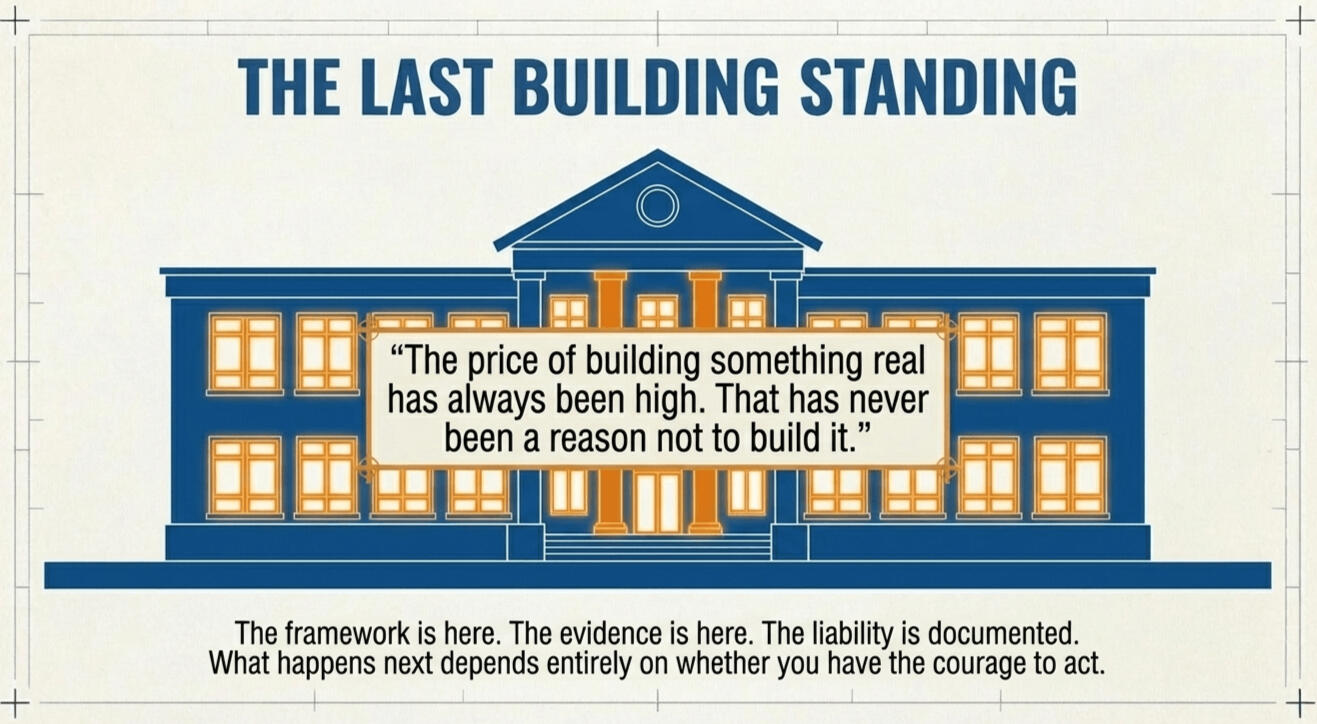
Chapter 5
"What We've Got Here Is a Failure to Communicate"
After notice, Inaction Is a Choice
Chapter GuideEvery chapter in this book has followed the same path. Identify the problem. Frame it so others can see it. Build a plan with clear first steps. Execute and iterate. That framework has held because the problems are real and the steps are honest.The first four chapters did the identifying and the framing. The phone problem is an attention problem. The AI problem is a thinking problem. The attendance problem is a presence problem. Each one traces back to the same structural failure: schools are tolerating conditions that make it impossible for teachers to teach and students to learn while addressing safety concerns. The solutions are straightforward. Remove the phones during school hours. Draw a clear line on AI at the point of cognitive effort. Make attendance mean something again.
- 105 -
This chapter is the plan and the execution. It is written for the people who have the authority to act, for the teachers who are living inside the dysfunction, and for the parents and community members who care about what happens inside the building. The first four chapters named the problems. This one names the path forward.Three Structural AsksEverything in this book comes down to three policy decisions. They are simple to name, supported by evidence, and aimed at restoring the preconditions that every school needs in order to function.A school-wide phone ban during school hours, aimed at restoring student attention. Chapter 2 laid out the case. Phones are engineered to capture attention. Self-carry policies fail because the mere presence of the device fragments focus. Schools that have removed phones report the same results: students talk to each other, teachers can hold the room, and the building comes back to life. Attention is the first thing a classroom needs, and the phone is the first thing that needs to go. There is a safety dimension here as well. Conflicts that start on social media during the school day spill into hallways and classrooms within minutes. Students film fights instead of stepping back or getting help. Drama that would have stayed outside the building now follows students into every class, every passing period, and every lunch hour because the phone keeps them connected to it in real time. Teachers are pulled into extra monitoring duties in hallways and bathrooms just to keep the building stable. Remove the phones and a significant portion of that daily chaos goes with them.A clear, enforceable AI policy, aimed at protecting student thinking. Chapter 3 drew the line. AI that assists a student who has already done the cognitive work is a tool. AI that replaces the student’s thinking is a shortcut that prevents the formation the assignment was designed to create. The standard is one question: did the student do the thinking? Without a district-level policy that answers that question, every teacher who tries to hold the line on academic integrity is standing alone. A teacher catches a student submitting work that AI produced. What happens next? There is no policy to point to.
- 106 -
There is no standard the district has set. The teacher becomes the one enforcing an individual standard. The institution never bothered to establish. That is what happens when leadership leaves a structural gap and expects teachers to fill it on their own. The teacher is not the one who failed. The institution left them without the ground to stand on.A meaningful attendance policy, aimed at restoring student presence. Chapter 4 made the argument. When attendance becomes optional, the institution loses its organizing principle. Two cultures are forming inside schools right now, one that believes showing up matters and one that believes completion is enough. They cannot coexist under the same roof without the serious students and the committed teachers paying the price. There is also a safety reality that leadership cannot ignore. When students are free to come and go during the school day, the school loses track of who is in the building. A student walks out at 10 AM, and the school is still responsible for that student. If something happens to them between the parking lot and wherever they end up, the institution owns that liability. And on the other side, if there is an emergency inside the building, leadership needs to know exactly who is present and who is not. An attendance policy is not just about academic investment. It is about knowing where your students are and being able to account for every one of them when it matters most.These three policies are the preconditions of school itself. Attention. Thinking. Presence. Without all three, the building is open but the school is closed.What Any Teacher Can DoThis book was written from my experience, but the framework is portable. Any teacher in any district who is facing similar structural failures can follow this process. It is professional, measured, and grounded in the same identify-frame-plan-execute approach that runs through every chapter.Identify the structural failures clearly. Be specific. Name the conditions that are preventing the school from functioning. Tie each one to a core requirement: attention,
- 107 -
thinking, or presence. Avoid vague complaints about morale or culture. Focus on the structural causes that leadership has the authority and the responsibility to address.Frame the problem so others can see it. A problem you understand but cannot explain to others is a problem you will solve alone. And you cannot solve this one alone. Put your concerns in clear, specific language that a principal, a superintendent, or a school board member can understand and act on. This is where the framing matters. You are not complaining. You are identifying structural conditions that are undermining the school's ability to fulfill its basic purpose.Propose reasonable remedies in writing. For me it is this book. You can use it too. Each concern should come with a specific policy recommendation. A phone ban for attention. An AI policy for thinking. An attendance policy for presence. Keep the asks grounded, actionable, and tied to legitimate educational purposes. Put it in writing. Email works. Keep a copy. Be professional, specific, and clear.Deliver it through proper channels and give leadership the opportunity to respond. Start with your principal. That is the person responsible for your building. If the building-level response is inadequate, bring the same written concerns to the superintendent. If the superintendent does not act, bring them to the school board. At each level, the documentation matters. Dates, emails, written responses, or the absence of responses. The goal is to build a clear, factual record that shows good-faith effort to improve the school through the proper channels.Bring others along. This is the part most teachers skip, and it is the part that matters most. One voice is easy to dismiss. A group of teachers, parents, and community members asking the same questions with the same evidence is a different conversation entirely. Share the framework. Share the data. Have the conversations in the faculty lounge, at the parent meeting, and at the school board session. The problems in this book affect everyone in the building. The solutions should come from everyone who cares about the building.
- 108 -
This process is designed to give leadership every opportunity to do the right thing. It is fair, measured, and professional. If leadership responds and the conditions improve, the process worked. If leadership does not respond, the record speaks for itself.What Leadership OwesI want to speak directly to superintendents and school board members for a moment.You are responsible for enormous, complicated systems. You face pressure from every direction. You inherit problems you did not create and manage budgets that never stretch far enough. I understand that. I spent over two decades running businesses in a regulated industry. I know what it means to make decisions where every option has a cost.What I also know, from those same two decades, is that once a problem has been clearly identified and formally brought to your attention, the decision to do nothing is still a decision. It carries consequences. And those consequences belong to the people who chose inaction.You do not have to agree with every teacher's proposal. You do not have to implement every recommendation exactly as written. What you cannot do is receive a clear structural diagnosis, a set of reasonable remedies tied to legitimate educational purposes, based on safety concerns and a formal written request through proper channels, and then pretend that doing nothing is a solution that in any way helps your teachers, students or families in the community.Doing nothing after notice is a choice. And the choice of avoidance is not the leadership a modern school can survive on.
- 109 -
The Cost of Doing NothingLeadership in every profession carries a specific obligation. The people at the top are responsible for the conditions under which the people below them work. A factory owner is responsible for the safety of the floor. A hospital administrator is responsible for the conditions inside the wards. A military commander is responsible for the readiness and welfare of the troops. When conditions deteriorate and leadership has been informed, the cost of that deterioration belongs to the institution.One of my assistant football coaches is also a school board member. Before that, he was a sheriff's deputy in our county and a Division of Gaming officer. He now works high-end security at a private club in the area. He has spent most of his career in jobs where the stakes can turn dangerous without warning.He has a line that has always stuck with me. He says: I get paid plenty for the things I do on a daily basis. I do not get paid nearly enough for the things I might have to do in the line of duty.That is exactly how teaching feels now. Teachers are compensated for instruction. They are compensated for lesson planning, grading, and classroom learning. What they are compensated for are the daily duties of a behavior de-escalation specialist. What they are absorbing, increasingly, are the consequences of structural decisions that leadership has refused to make. The hallway monitoring. The bathroom patrols. The unpredictable behavior in buildings where phones remain unrestricted, attendance is optional, and standards have quietly eroded. Add being prepared to defend yourself and your students against an active shooter and you get the ultimate unpaid sacrifice. Those are the things teachers are not paid nearly enough for, and those are the conditions leadership has the power to change.When schools fail to act on known structural problems, the cost shows up in predictable ways. Teachers leave. The ones who stay absorb more stress, more duties, and more risk. Students with engaged families transfer out, and the population of the building tilts further toward the most difficult situations. Substitutes become harder to find. The school's reputation in the community erodes. Enrollment drops. Every one of those
- 110 -
outcomes becomes evidence that the institution failed to manage conditions it had the authority and the information to address.The staffing crisis in American education is real, and it is getting worse every year. There are many reasons for that, and some of them are beyond any single district's control. One reason that is entirely within a district's control is whether the working conditions inside the building are safe, stable, and structurally sound. A school that refuses to remove phones, enforce attendance, or establish clear AI policies is a school that has chosen to make the working conditions harder for every teacher in the building. When those teachers leave, leadership should not act surprised. The conditions that drove them out were identified, reported, and left unaddressed.Every business owner knows this. In that world, when a problem was identified by a regulator or an internal audit, you fixed it. You did not schedule a training day about it. You did not hire a consultant to study it for six months. You fixed it, because the cost of inaction was clear. Schools operate with far less external accountability than a casino, and that is part of the problem. The principle is the same. When leadership knows about a structural failure and chooses to tolerate it, the leaders own everything that failure produces.The Safety ParadoxThere is one more thing that needs to be said about what is happening inside schools right now, because it reveals a failure of priority that should concern every parent and board member.Schools across the country have invested heavily in emergency preparedness. Active shooter drills. Lockdown procedures. Communication apps that allow staff to report their injury status to first responders in real time. These preparations are serious and they are necessary. Nobody questions the need for them.
- 111 -
Here is the question that should keep leadership up at night. If we take extreme safety scenarios seriously enough to invest in apps, drills, and training, why are we ignoring the daily structural conditions that are making our buildings chaotic, disorderly, and increasingly volatile? We prepare for the worst-case scenario while tolerating the everyday conditions that are driving the building toward it.A school-wide phone ban would reduce chaos, improve attention, and give teachers back control of their classrooms. A meaningful attendance policy would stabilize the population of the building and restore consistency. A clear AI policy would reestablish academic integrity and give students a reason to invest in their own work. These are basic structural changes. They would improve the safety and function of the school.The conversation about school safety should start with the conditions inside the building every single day. If leadership cannot get the daily environment right, no amount of emergency planning will compensate for it.The Three Pillars, Turned Toward LeadershipMy first book was built on three pillars: responsibility, real rewards and consequences, and adults who neither rescue nor abandon. I wrote them for coaches and teachers, about how to build young leaders. In this chapter, I am applying them to the people who lead the leaders.Responsibility. If you are a superintendent or a school board member, you are responsible for the structural conditions of your schools. You inherited a system under enormous pressure from forces that did not exist a generation ago. That is true. It is also true that you accepted the role, and the role carries a duty to respond when structural failures are identified and formally reported. Responsibility requires response.Real rewards and consequences. When a teacher raises a legitimate structural concern through proper channels, the institution's response matters. If good-faith efforts are met with silence, delay, or another round of consultant-led training that
- 112 -
avoids the actual problem, the message is clear. The institution tolerates honest engagement until the teacher gets tired and leaves. That pattern has consequences, and they are already visible in the staffing crisis facing schools across the country.Adults who neither rescue nor abandon. This book is an act of investment, not abandonment. Every chapter, every argument, every formal request through proper channels is evidence that the people raising these concerns still believe schools can be the places they are supposed to be. What those people will not do is rescue leadership from the consequences of inaction by staying silent. If teachers have done their part and leadership has not done theirs, the community deserves to know.What I Believe Will HappenI believe that when the right people see the full picture, they will act. Most administrators got into education for the same reason most teachers did. They care about young people. They want schools to work. The structural problems in this book are serious, but they are also fixable. The asks are reasonable. The evidence is clear. The path forward is specific and actionable. When the community comes together around these issues and presents them through the proper channels, I believe leadership will respond.That is the bet this book makes. It bets on the good faith of the people who have the authority to make structural decisions. It bets on parents who will show up to board meetings with questions and evidence. It bets on teachers who will put their concerns in writing and trust the process. If everyone does their part, the conditions inside our schools will improve. I have to believe that, because the alternative, good people seeing the problem clearly and choosing to look away, is hard to accept. And if a teacher reaches the end of that process and the conditions still have not changed, what does a teacher do next? Nobody should be expected to keep working inside conditions that the people above them were informed about and chose to leave in place.
- 113 -
What This Has Always Been AboutI have spent most of this chapter talking about leadership, accountability, community action, and institutional responsibility. I needed to. Those are the mechanics of how this gets fixed.But that is not why I wrote this book.I wrote this book for the kid sitting in the third row who does not yet know what they are capable of, because nobody has required enough of them to find out.I wrote it for the freshman who shows up every day, does the work, and watches a classmate who barely attended walk across the same stage at graduation in the end. I wrote it for the student who could have discovered something real about themselves in a classroom where attention was protected, thinking was required, and adults held the standard. That student never got the chance because the building was too busy managing chaos to offer anything worth investing in.These are the years that matter. Young people get a short window where they can discover what kind of person they want to become. They get a handful of years where adults who believe in them can require something difficult and watch them rise to it. Those years do not come back. Every day we fail to make the structural decisions that protect them, we are spending time that belongs to someone else's future.A school-wide phone ban during school hours gives students their attention back. A clear AI policy gives students their thinking back. A meaningful attendance requirement gives students their presence back. These policies protect the conditions under which real growth happens. They protect the years that matter most. The policies make for a safe haven for students and their teachers.The adults in the building already know this. The teachers have known it for years. What they need is leadership that will stop hiring consultants to manage the symptoms and start making the decisions that address the cause.
- 114 -
What young people want is more than finding a way to climb the job ladder until old age claims them. They want to know what they are made of. They want to be asked for something real. School is the place where that happens, if we protect it.We are the Last Building Standing in our communities.This book is the case for protecting it. The framework is here. The evidence is here. The path forward is here. What happens next depends on the people who read these pages and decide whether to act.After notice, inaction is a choice.Choose to build something real.End Chapter: Chapter 5 - Administrative Duty and Safety Note
School leaders have a duty to respond when unsafe conditions, weak policies, or repeated breakdowns in structure place students and staff at risk. When known problems are left unaddressed, the burden of that failure is pushed onto teachers and students who are expected to function without adequate protection or support.Book EndReach out to Coach Ball if you have questions or need me to produce any policy change document drafts for review. These types of policy documents and procedural frameworks are my speciality.[email protected]
720.751.8771 Call or Text
- 115 -